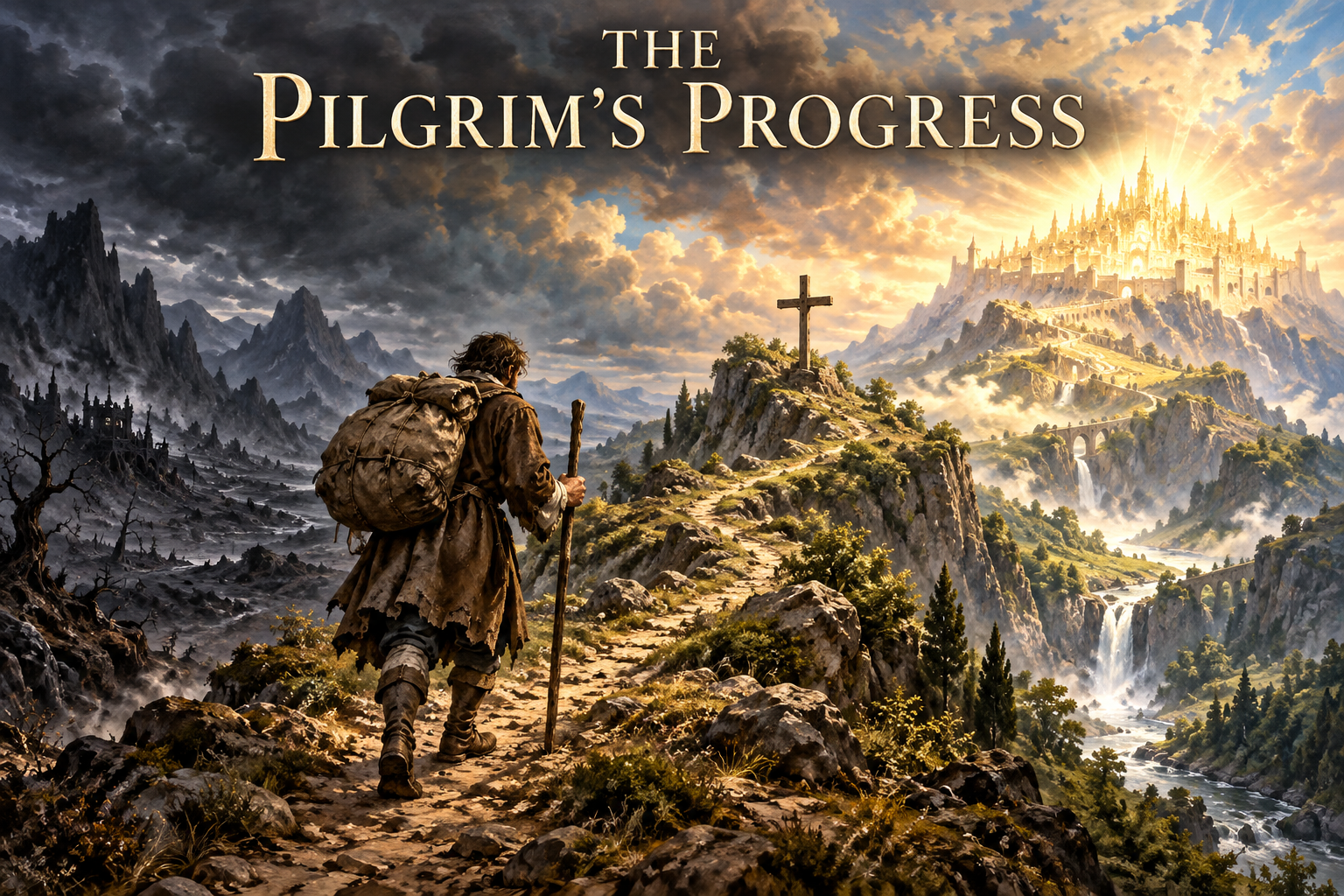
The first book I ever read was The Pilgrim’s Progress by John Bunyan.
Looking back, there is something meaningful about beginning my reading life with a journey. Before so many other books, songs, and stories became part of my world, there was a pilgrim named Christian, carrying a burden and searching for the way forward.
Bunyan’s story follows Christian from the City of Destruction toward the Celestial City. Its landscape gives visible form to spiritual struggle: the road becomes a place where faith, fear, temptation, and hope take shape. (ccel.org)
Today, I see a connection between that pilgrimage and what we call the hero’s journey.
A person hears a call. Familiar life becomes impossible to continue in the same way. A threshold must be crossed. Help arrives. Trials reveal weaknesses. Something within the traveler changes.
That pattern helps me think about Christian’s story, although his pilgrimage has its own Christian purpose. His destination is communion with God, and his progress depends on grace.
The great question is how a burdened person learns to receive that grace—and keep walking.
The journey begins with honesty
Christian begins with a book in his hand and a heavy burden on his back. He knows that something is wrong, and he cannot simply forget what he has learned. (ccel.org)
That image still speaks.
Many journeys begin with a moment when we finally admit what we have been carrying. Regret. Fear. Pride. The consequences of our decisions. The exhaustion of trying to appear stronger than we feel.
For me, this is where the hero’s journey becomes personal. The first courageous act can be telling the truth.
“I need help.”
“I have something to learn.”
“I cannot keep going this way.”
Those are small sentences, but they can change the direction of a life.
Knowing the destination doesn’t reveal the whole road
We can become excited about a vision before we understand what pursuing it will require.
We imagine reconciliation, healing, meaningful work, a stronger faith, a better life. We see the destination with enough clarity to want it.
Then comes the daily work.
Patience. Discipline. Listening. Apologizing. Starting again. Following through when nobody is watching.
Christian’s road makes me think about the distance between wanting transformation and participating in it. A meaningful destination gives us direction, but we still have to take the next step.
Sometimes that step is ordinary enough to overlook: keeping a commitment, accepting correction, asking forgiveness, or showing kindness while we are tired.
Those moments belong in the story, too.
The burden falls at the cross
One of the central scenes in Bunyan’s book comes when Christian reaches the cross. The burden loosens from his shoulders and falls away. His relief comes through what he encounters there. (ccel.org)
For me, that scene changes how I understand heroism.
There is courage in perseverance, and there is courage in surrender. There is strength in doing the work before us, and humility in recognizing that we cannot manufacture our own redemption.
The Christian life asks us to act, repent, forgive, and love. It also asks us to receive.
Christ’s invitation remains:
“Come to Me, all you who labor and are heavy laden, and I will give you rest.” —Matthew 11:28
That invitation gives the weary traveler somewhere to bring the weight.
We need companions
A journey changes when someone walks beside us.
In Bunyan’s story, companions such as Faithful and Hopeful matter. Later, the second part follows Christian’s wife, Christiana, and their children on their own pilgrimage. The story widens beyond one traveler. (ccel.org, ccel.org)
That feels true to life.
A friend can remind us of something we have forgotten. A mentor can ask a question we have avoided. Someone who has traveled a difficult stretch can help us recognize the next turn.
Sometimes love looks like encouragement. Sometimes it looks like an honest conversation.
I’m grateful for the people who walk with me, especially those who care enough to speak truth and stay present. We all need people who can see our possibilities while helping us face our responsibilities.
And we have opportunities to offer that same friendship to someone else.
Despair doesn’t get the final word
Christian and Hopeful’s captivity in Doubting Castle is one of the book’s strongest images. Their escape becomes possible when Christian remembers the key called Promise. (ccel.org)
I read that scene as a reminder of how narrow our vision can become when we are discouraged.
We forget previous kindnesses. We lose sight of available help. We begin treating a painful moment as though it explains our entire future.
Remembering can be an act of faith: remembering God’s promises, remembering what is true, remembering that we can reach out.
Hope can begin quietly. A prayer. A conversation. A willingness to try again.
The first book still has something to teach me
I find it moving that the first book I ever read was about a traveler learning how to continue.
I’m still thinking about its questions.
What am I carrying? Where am I headed? Whose guidance am I willing to hear? How can I become a better companion? What does faithfulness require of me today?
The hero’s journey gives us a language for transformation. The Pilgrim’s Progress gives that journey a distinctly Christian center: the cross, the promises of God, and the hope of arriving home.
For today, I can keep learning. Keep praying. Keep accepting help. Keep doing the good that is within reach.
One faithful step at a time.
JC