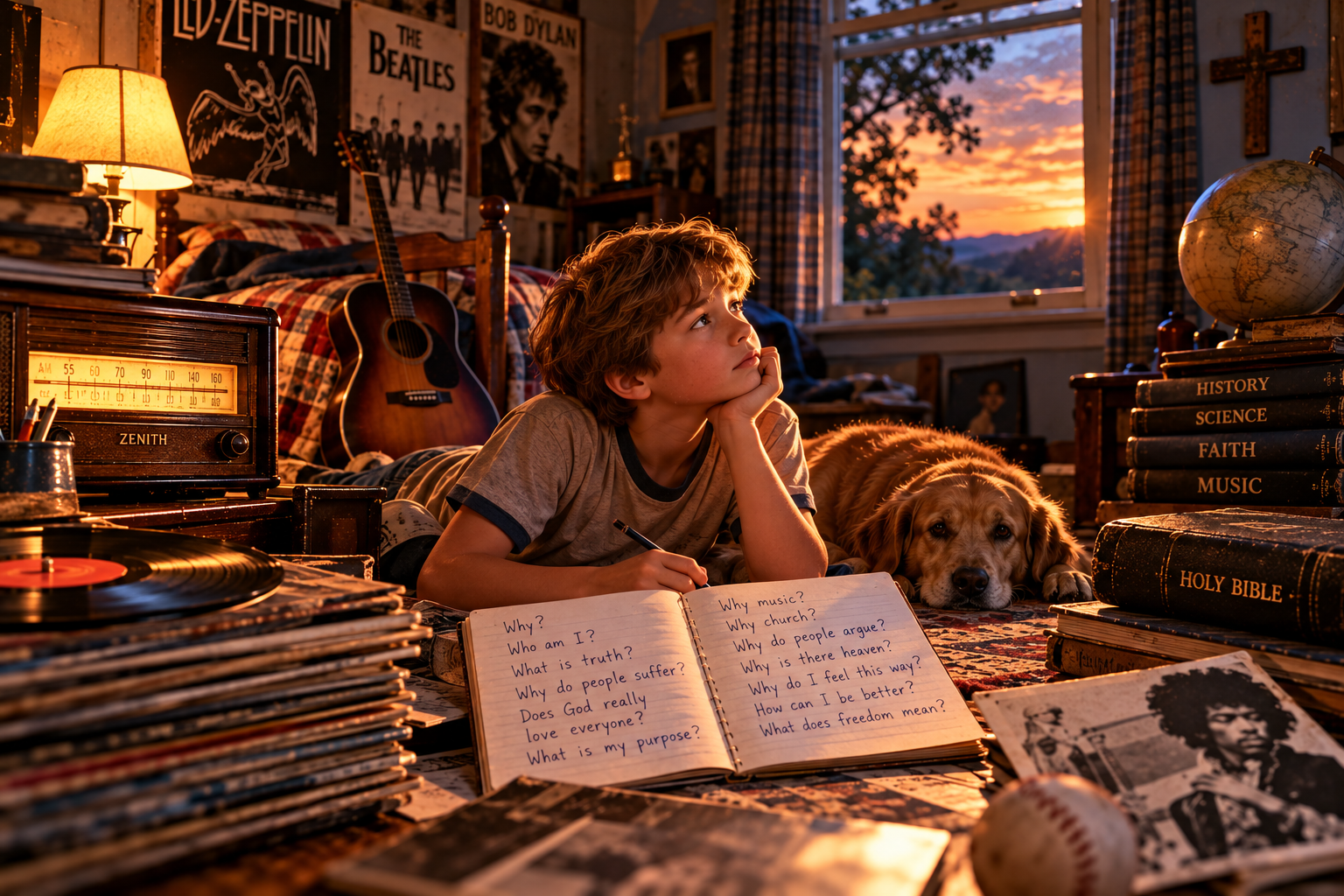
The Boy Who Asked Why
The trouble began with a question. It usually did.
I cannot remember which adult first told me to stop asking why. There were several candidates, all respectable people who had better things to do than explain the architecture of the universe to a boy with grass stains on his knees.
Why did we go to church on Sunday? Why did the preacher wear a suit? Why did people say God loved everybody, then spend the drive home explaining which neighbors were beyond hope?
I wasn’t trying to be difficult. Difficulty was simply a byproduct of curiosity, like sawdust from a carpenter’s shop.
At school, questions had approved answers. The teacher asked, we raised our hands, and somebody received a gold star. I liked gold stars well enough. But the questions that followed me home were rarely on the test.
Why could a good man make a cruel remark? Why could a kind woman become silent when she was hurt? Why did adults call an argument a discussion when they were winning and disrespect when they were losing?
I noticed these things without understanding them. Children are excellent witnesses and unreliable judges. We see the expression on a face but seldom know the history behind it.
My father valued certainty. He believed decisions mattered and that a person ought to stand behind them. There was strength in that. My mother had a gift for hearing what someone meant beneath what they said. There was strength in that, too.
I wanted both gifts, though I was better at borrowing the certainty than practicing the listening.
One afternoon I sat with a Bible open on my lap, studying the story of Thomas. Everybody seemed annoyed with him for wanting evidence. Yet when he asked to see the wounds, Jesus answered him. I wondered whether doubt might sometimes be an invitation rather than an insult.
I did not announce this theory at dinner. Even young philosophers recognize a room with limited appetite for philosophy.
Music offered another kind of evidence. A chord either rang or it didn’t. You could argue about whether a song was beautiful, but you couldn’t talk a broken string into making a note. Practice taught me to test what I believed against what I heard.
It was a useful lesson, though I would later forget it whenever my own opinions sounded especially convincing.
I grew older and discovered that being right could feel intoxicating. You could win a debate and still lose a friend. You could deliver a magnificent speech and leave the person across from you feeling smaller. Applause was not the same as peace.
I wish I had understood that earlier.
The questions themselves were not the problem. They had opened books, introduced me to music, and pushed me toward people whose lives looked nothing like mine. The problem came when I treated questions as weapons rather than doors.
I could ask why someone had disappointed me without asking what pain they were carrying. I could demand an explanation while refusing to offer patience. I could insist on the truth and still neglect kindness.
That was not courage. It was curiosity without humility.
But I am getting ahead of the boy.
He is sitting on the floor beside a radio, turning the dial between stations. Static crackles, voices fade, a trumpet rises and disappears. He keeps searching because he believes something worth hearing is out there.
I would like to sit beside him for a minute. I would tell him to keep asking why, but to leave room for another person’s answer. I would tell him that wisdom sometimes speaks softly, and that silence is not always surrender.
Mostly, I would listen with him.
Many long years lie ahead: stages, churches, rooms where people disagree, and silent rooms. He will not always listen well. But the music will keep reminding him that harmony requires more than one voice.
The dial turns. A song comes through clearly.
For once, neither of us asks a question.