
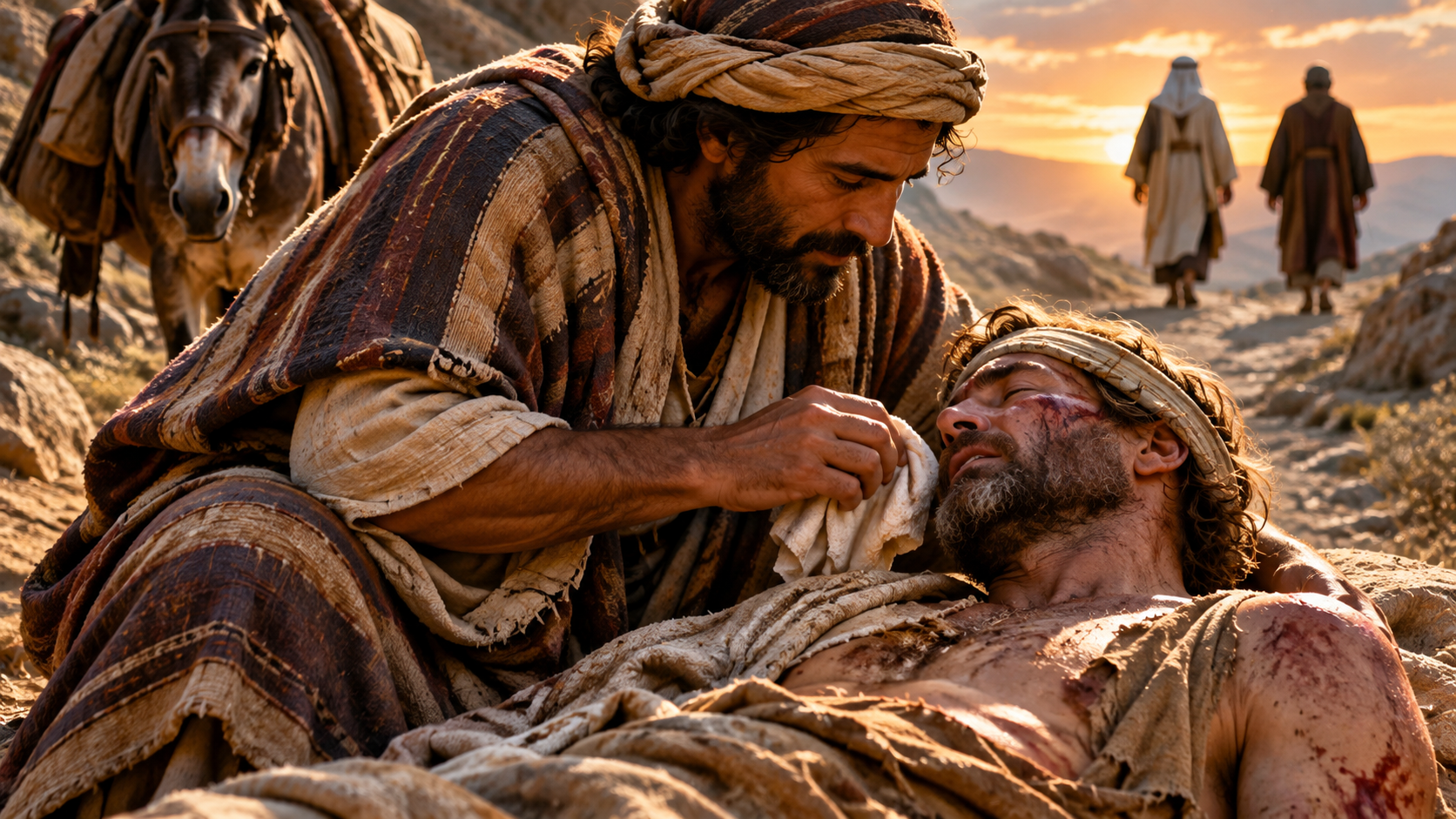
The priest knew the Scriptures. The Levite knew the law. Both understood the temple, its rituals, its traditions, and its theology.
And both walked past a broken man lying in the dirt.
Then came the Samaritan.
He didn’t possess the right religious credentials. He belonged to a people despised by much of the religious establishment. He wasn’t the person anyone expected Jesus to make the hero of the story.
But he stopped.
He saw suffering and responded with compassion. He dressed the man’s wounds, placed him on his own animal, brought him to safety, and paid for his recovery.
He didn’t organize a committee. He didn’t demand that someone else solve the problem. He didn’t wait for institutional permission.
He loved his neighbor at his own expense.
That’s the politics of the Kingdom of God.
Not the politics of left versus right, Republican versus Democrat, or one denomination against another. The politics of a Kingdom where love becomes action, compassion requires sacrifice, and faith produces good works.
The priest and Levite may have possessed impressive religious knowledge, but their knowledge did nothing for the wounded man.
The Samaritan’s theology was demonstrated through his actions.
And here’s the uncomfortable question Jesus leaves us with:
How often do we spend our lives defending what we believe while walking past the very people we’re called to love?
We can win every theological argument and still miss the heart of Christ.
The Kingdom isn’t advanced merely by winning arguments. It advances when we feed the hungry, visit the prisoner, welcome the stranger, forgive our enemies, and lift our neighbors out of the mud.
The question isn’t simply whether we have the right doctrine. It’s whether our faith moves us to love.
Jesus didn’t finish the parable by telling the lawyer to go and win an argument.
“Go, and do thou likewise.” — Luke 10:37 (KJV)
Good News. Good Music. Good Works.
JC






Leave a Reply