By JC
A deck of cards is fifty-two cards in four suits, plus two jokers nobody invited, and one card most people throw away without reading. I have shuffled this deck my whole life and never once asked what it was trying to tell me. Today I’m asking. We’ll walk through it in order, and I’ll save the best card for last, because the best card is always the one people skip.
The Suits. Four of them, and each one is a way of living. Hearts are love, the thing every other suit is supposed to serve. Diamonds are treasure, what we store up and what we’re tempted to trust. Spades are labor, the work of hands, and also the sword of the Spirit, which is the word of God. Clubs are the shepherd’s staff, the tool a good shepherd uses to guide the sheep and fend off the wolves. Notice that none of the four suits is bad. Every one of them is good when it’s pointed in the right direction and ruinous when it isn’t. Love without truth turns sentimental. Treasure without generosity turns into rot. Labor without rest turns into slavery. And a staff without gentleness turns into a club in the other sense of the word.
The Kings. One king per suit, and I’ve gone with Scripture’s own. David holds spades, the warrior with the sword who wrote the psalms. Solomon holds diamonds, the richest and wisest man of his age. Hezekiah holds hearts, the king who spread a threatening letter out before the Lord and prayed. Josiah holds clubs, the young shepherd-king who found the lost book of the law and led the nation back to it. Here’s the thing about these four. Every one of them was a good king, and every one of them fell short. David had Bathsheba. Solomon married his way into idolatry. Hezekiah showed the Babylonians everything in the treasury. Josiah died in a battle he didn’t need to fight. They are the setup. They are the question the deck is asking: where is the king who doesn’t fall short?
The answer shows up in Genesis and then waits a thousand years. Melchizedek, king of Salem, priest of God Most High, meets Abraham after the battle, brings out bread and wine, and blesses him. Abraham, the father of the whole nation, hands him a tenth. Then Melchizedek vanishes from the story, no father, no mother, no beginning, no end recorded. Hebrews picks him up and says that’s the pattern for Christ, a priest forever, king of righteousness, king of peace. Every king in the deck points at him. Every king in the deck bows to him.
The Queens. Four women, one per suit. Deborah holds spades, the judge who sat under a palm tree and told the general when to go to war. Ruth holds diamonds, the foreigner who clung to her mother-in-law and found herself in the line of David. Esther holds hearts, the queen who risked her life by walking uninvited into the king’s presence and said, if I perish, I perish. Abigail holds clubs, the wise woman who met an army with bread and talked a future king out of a bloodbath. Courage, loyalty, bravery, wisdom, and every bit of it in service to someone else. Not one of these women was famous for being in charge. They were famous for being faithful when it counted.
The Jacks. The jack is the youngest of the court, the servant, the one still growing into the job. Samuel holds spades, the boy who heard his name called in the night and answered, speak, Lord, your servant is listening. Joseph holds diamonds, the dreamer who went from the pit to the prison to the palace without ever letting go of God. Timothy holds hearts, young in age, faithful in heart, told by Paul not to let anyone look down on his youth. And David holds clubs, the shepherd boy with a sling who showed up at the battle line carrying cheese for his brothers. Yes, David is both a king and a jack. That’s not a mistake. Every king was a jack first.
And since I promised you a cartoon, there’s Jack-Jack from The Incredibles. He’s the baby of the Parr family, and everybody thinks he’s ordinary until the powers show up, all of them, all at once, in a hallway with a raccoon. That’s the jack. Looks like nothing, carries more than anybody has noticed.
The Numbers. Ace through ten, and Scripture has been counting for us all along. The ace is one, one God, one Lord, one faith. The two is the two witnesses, because every matter is established by two or three. The three is the Trinity, Father, Son, and Spirit. The four is the four Gospels, four angles on one life. The five is the Torah, the five books of Moses. The six is man’s number, made on the sixth day, always one short of seven. The seven is completion, the day God rested and called the work finished. The eight is new beginnings, the day after the Sabbath, the day of the resurrection. The nine is the fruit of the Spirit, love, joy, peace, patience, kindness, goodness, faithfulness, gentleness, and self-control. And the ten is the Commandments, the law written in stone. Count them with me and you’ve walked from one God to ten words, and the ten words are looking for something to fulfill them.
The Jokers. Two extras, and both of them wild. They aren’t in the fifty-two, they don’t belong to a suit, and they don’t follow the rules. One of them is the deceiver. He is the counterfeit, the one who copies what’s real well enough to fool you. He quoted Scripture to Jesus in the wilderness, which tells you everything you need to know about how clever he is. The other is the fool in the Proverbs sense, the one who says in his heart there is no God and lives like there’s no rule card. He isn’t a bad man so much as a man who never read the instructions. Neither joker is the point. Neither one is the one to follow. They’re the two ways to lose the game: lie about it, or pretend there’s no game.
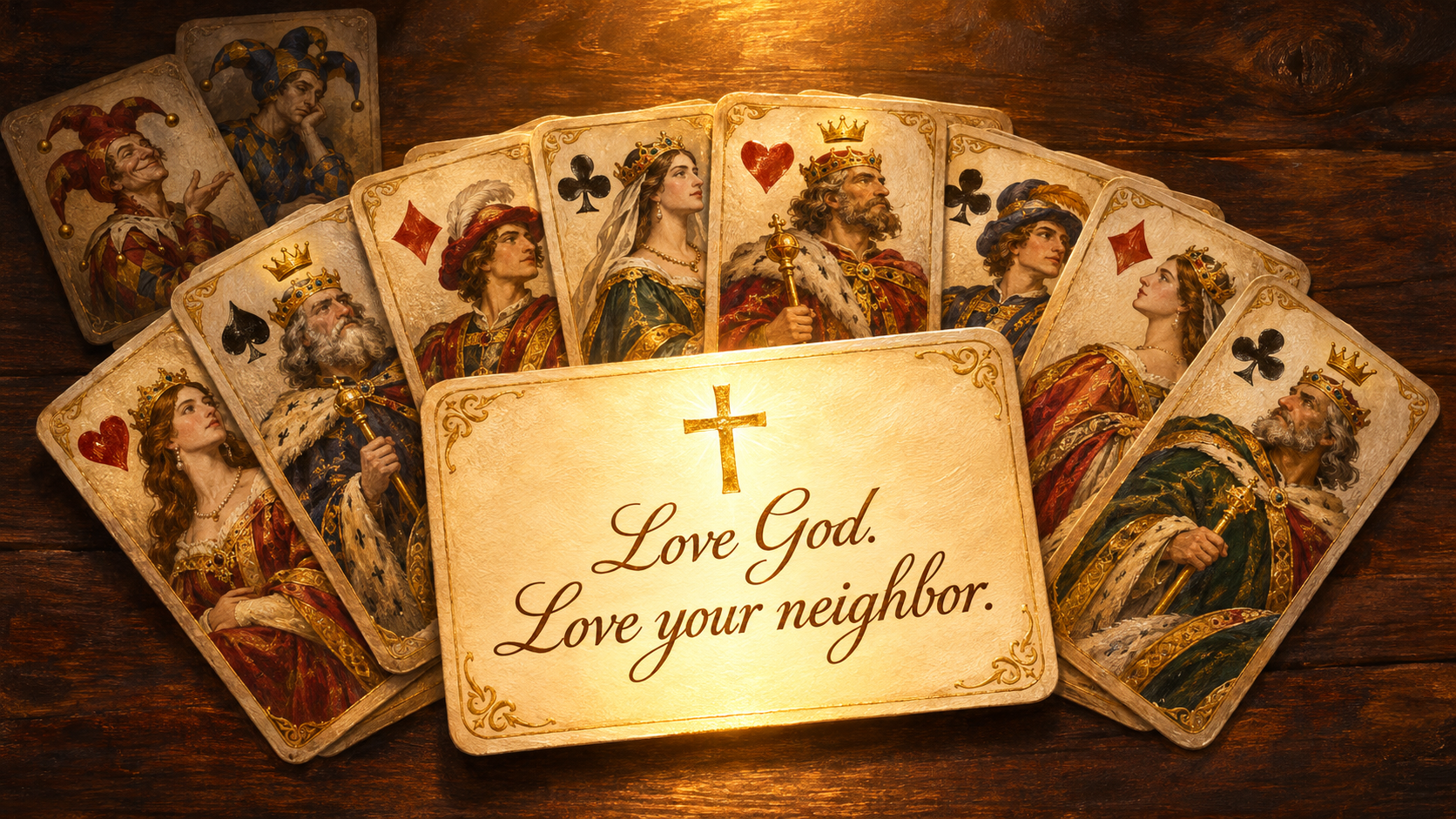
The Rule Card. And then there’s the card on top. Almost every deck has one, a card that explains the game, and almost nobody reads it. We shuffle past it, drop it in the box, and play by guesswork. In this deck, the rule card says one thing. Love the Lord your God with all your heart, with all your soul, with all your mind, and with all your strength, and love your neighbor as yourself. That’s the rule of Christ. Jesus said everything in the Law and the Prophets hangs on those two. Every king, queen, jack, and number in the deck only makes sense once you’ve read the rule card. The kings fell because they forgot it. The queens shone because they kept it. The jacks grew up by learning it. The numbers count toward it. And the jokers are what happens when you ignore it.
So here’s my advice, from one longtime card shuffler to another. Read the rule card first. It’s the shortest card in the deck and the only one that tells you how to play.