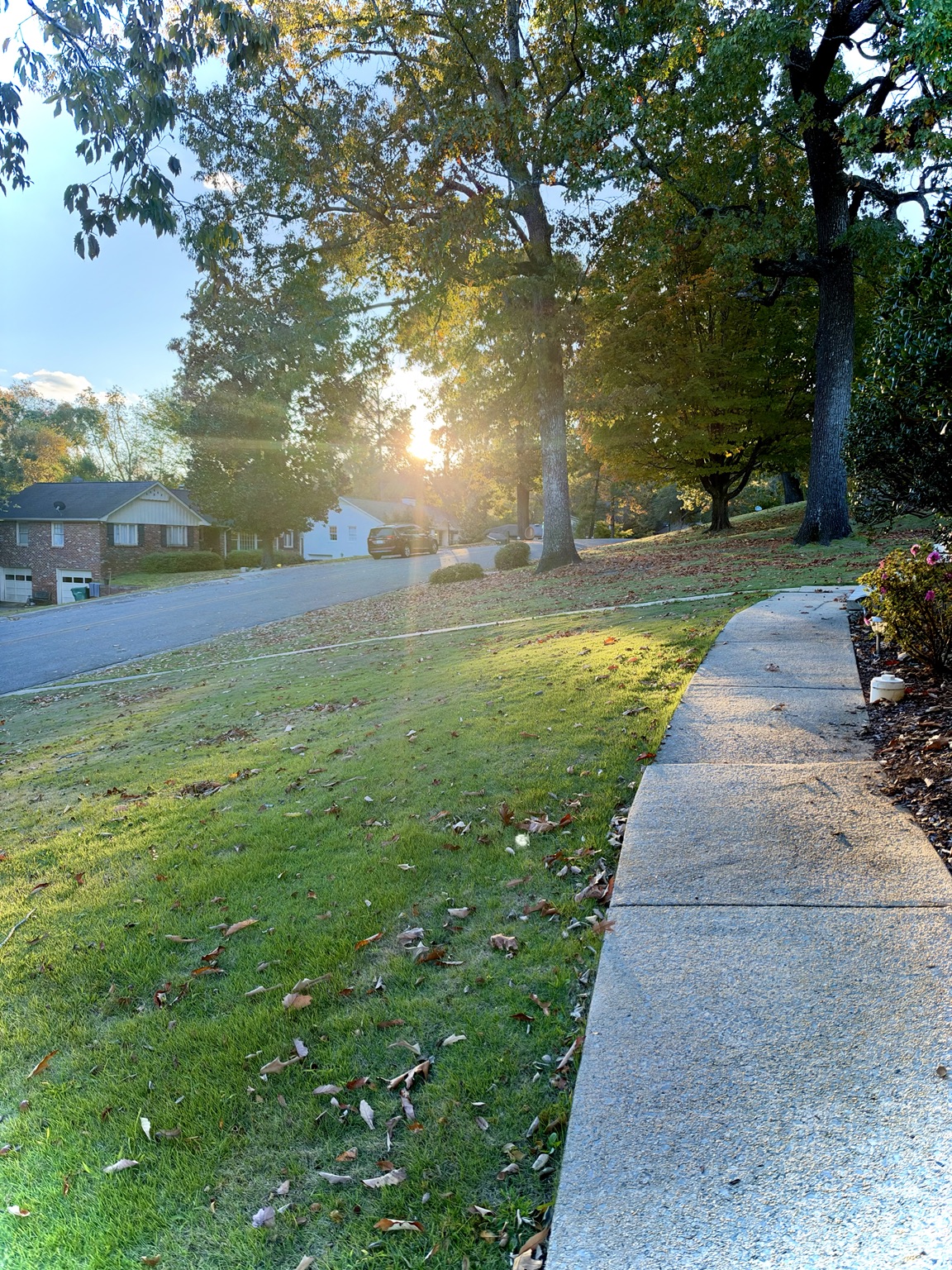
The sun was low enough to shine between the trees and lay a strip of gold across the sidewalk. A few leaves had come down. Across the street were the same houses I’d seen a hundred times. I took a picture because, for a minute, I saw the whole street again.
There’s a car up the hill, a brick house across the way, and a little patch of flowers at the edge of the frame. The sidewalk takes a bend and disappears. The sun is right where any sensible photographer would tell you to keep it out of the picture. I left it in. It was the reason I stopped.
I call this place the Tiny Kingdom. My claim to the throne extends about as far as the leaves I’m supposed to rake. Even there, the trees seem to have the final word.
The roads followed the hills
Mountain Brook took shape in the late 1920s on the Shades Valley side of Red Mountain. Birmingham developer Robert Jemison Jr. brought in landscape architect Warren H. Manning, and between 1926 and 1929 their team laid out Mountain Brook Estates. The land was hilly and wooded. The planners used its slopes, trees, and views to decide where roads and houses would go. They set aside room for recreation and brought shops and other gathering places into the plan. Birmingham Historical Society
The Birmingham Historical Society describes how springs, rock formations, and existing trees helped determine the shape of individual lots. The team figured out where a house would sit before working out how the driveway would reach it. Think about how much easier it would have been to draw a grid, divide it into equal rectangles, and get on with selling them. Somebody had to go out on the ground and pay attention to what was there. Birmingham Historical Society archives
You can appreciate what that meant without ever looking at an old plat. A road goes around a rise, and for a few seconds you see only the trees ahead. Then it turns and there’s a house set back from the street, or a view between two roofs you would have missed if you’d been looking down. On Liberty, my Harley, I get to feel those turns as well as see them. A short ride can take a while if I give myself permission to enjoy it.
Looking at the picture, I can see how much the hill contributes to an ordinary street. The house across the way sits lower. The lawn rises toward the trees on the right. The sunlight catches one stretch of grass and leaves another in shade. I’ve probably walked right through that same patch of light while thinking about something I’d forgotten to do. On this particular day, whatever I’d forgotten could wait another minute.
A mill that served tea
Shades Creek was part of the landscape long before Mountain Brook had a city hall. It also gave the new development one of its defining features. Mountain Brook Parkway ran alongside what became Jemison Park, a long strip of parkland laid out in the creek’s floodplain. The early development included bridges, stone entrances, and bridle trails. The creek gave the planners a place to put the park, and the park gave people a reason to spend time beside the creek. Birmingham Historical Society
Then there’s the Old Mill. It looks like the sort of building where somebody spent forty years grinding corn and complaining about the price of it. The building was designed in 1927 to help promote Mountain Brook Estates and opened as a tearoom. Across the way stood a house modeled on George Washington’s Mount Vernon. A visitor could stop for tea and have a look at what Jemison and his team were building. The Old Mill never ground a sack of grain. It turned out to be quite good at getting people to look. Birmingham Historical Society archives
I like the amount of effort they put into selling a lot. A map and a price might have done the job for some buyers. Jemison gave them somewhere to sit. A couple could talk over a cup of tea, go out and look at a hillside, and try to imagine which window would catch the morning light. A place begins to feel real when you can picture what you’d do there on a Tuesday.
Shades Creek has a life well beyond Mountain Brook. It winds through other communities in the Birmingham area and beyond, and its history takes in industry, settlement, and the work of people who have tried to protect the water. I like remembering that when I’m beside it. A city line can tell you who maintains the road. The water keeps going. Birmingham Historical Society
A city made up of villages
English Village, Mountain Brook Village, and Crestline Village each give people a place to go close to home. Mountain Brook Village took cues from the English countryside, and the city’s planning history traces some of the thinking behind the development to the Garden City movement. That idea had traveled a long way before it reached Alabama. Its appeal here is easy to understand. A person could live near woods and open land and still have shops and places to meet within the community. Mountain Brook Village Master Plans
The early community still depended on cars. Birmingham’s streetcars didn’t reach the development, so paved roads mattered to the people buying homes there. Once you’re in one of the villages, though, the scale changes. You can park, walk a little, and see who’s out. There’s always the possibility that the errand you meant to finish in five minutes will take twenty because somebody asked how you were doing and waited for the answer. Encyclopedia of Alabama
The architecture gets plenty of attention. Tudor buildings helped establish the early look, and there were also houses built in Georgian, Italianate, and French Norman styles. You can spend an enjoyable afternoon looking at rooflines and stonework. I usually end up looking at what people do with the space in front of a building. A bench in the right place will tell you quite a bit. Put it in the shade where somebody can see the street, and you’ve given a person somewhere to rest while the rest of the day goes by. Encyclopedia of Alabama
Mountain Brook’s development had its share of setbacks. During the Depression, some shareholders had to sell, lots went unbuilt, and some houses were boarded up. The community recovered as Birmingham did during World War II, and Mountain Brook incorporated in 1942. There were years between the handsome drawings and a city that could stand on its own. Imagine walking past a boarded house on a road laid out with such confidence a few years earlier. You’d have had to take quite a bit of the future on faith. Encyclopedia of Alabama
What it means to love a place
The original development was restricted to white residents. That belongs in the history alongside the care that went into the landscape. People were deciding which trees to preserve and where families could build homes, and they were also deciding which families could buy them. Those choices were made by people, just as the choices we make about welcoming our neighbors are made by people today. Encyclopedia of Alabama
I think about the word neighbor when I look at this picture. From the lawn, you can see the windows and driveways across the street. You can see where somebody has to come out and roll a garbage can to the curb, where somebody pulls in after work, where somebody might stand and wait for a ride. I’ve lived around here long enough to know how easily a familiar face can go from a wave to a conversation if one of you has a little time.
Jesus made loving your neighbor part of the work of loving God. Some days that looks as ordinary as learning a name or listening when somebody needs to talk. There’s a little of that in the best moments of small-town life. The fellow who’s lived here fifty years and the person who got here last Tuesday can both stand on the same sidewalk and watch the sun come through the same trees. I hope both feel at home enough to stop for a minute.
And a town is full of people who look after things in ways you might miss if you’re only passing through. Somebody clears a branch from the sidewalk after a storm. Somebody keeps an eye out for the older neighbor who usually comes by about this time. Somebody plants flowers at the edge of a walk where the people going past get almost as much pleasure out of them as the person who put them there. I see a little of that in the right-hand corner of this picture. Whoever planted those flowers gave the light something else to catch.
A tree takes longer to grow than a house takes to build. I suppose that’s part of what I admire about the early plan. The people drawing it could put a road on paper in an afternoon. The shade they wanted was already there, the work of decades they had nothing to do with. A person building on one of those lots had a chance to leave something standing that would make the next person’s afternoon a little cooler. So does the person who plants a tree today, although they may have to wait a good while to enjoy it.
That makes a walk through town feel a little different. Look up and you can see branches that reach over the street from both sides. The trunks are on separate lots, but the shade falls wherever it falls. A kid coming home from school gets some. So does the person walking a dog, or the fellow standing around with a phone in his hand trying to take a picture without stepping backward into the flower bed.
The light on the sidewalk
I could have used a picture of the Old Mill for a post about Mountain Brook. I could have taken a photograph in one of the villages, where somebody who grew up here might recognize the spot before reading a word. I wanted this picture because the town spends most of its time looking something like this. There are cars in driveways. There’s a bit of yard work to do. The street goes uphill, and somebody walking it has a decision to make about whether to keep going or turn around.
A photograph can make a few seconds look like a permanent condition. That streak of light was moving while I stood there. It had already passed over some of the lawn and would be gone from the sidewalk soon enough. The leaves still on the trees had a few more windy days in them. By winter there will be a much bigger piece of sky visible from that same spot. I’ll have walked past it plenty of times by then and probably spent half those walks looking at my phone.
There’s a particular pleasure in recognizing a place by its small details. I can look at that curve in the walk and feel how my feet would take it. I can see the sunlight crossing the grass and remember how the street looked a moment before I raised the camera. The photograph will be useful to me later for that reason. Years from now, I suspect I’ll spend as much time looking at the ordinary brick house in the background as I will at the sun.
I’m grateful Jemison and Manning gave the hills and trees a say in what Mountain Brook became. I’m grateful for the people who have looked after the creeks, the parks, the gardens, and the little pieces of ground entrusted to them since. On the day I took this picture, the gift of all that care was a quiet stretch of sidewalk where I could stand long enough to see the light move.
That’s a good afternoon in the Tiny Kingdom. I’ll get to the leaves tomorrow.