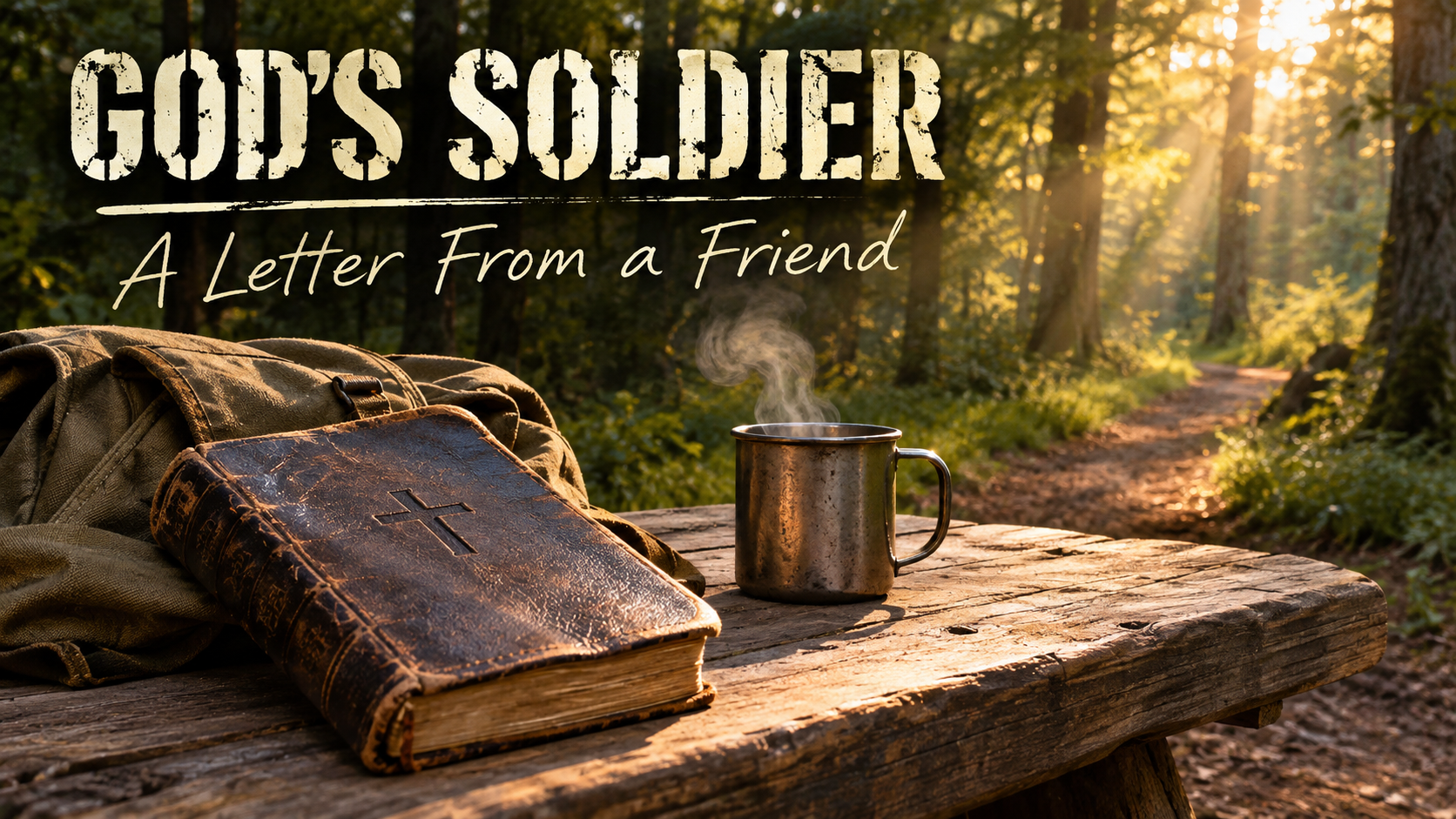
Some thoughts from a friend I met yesterday morning, who sent me another message today. Yesterday, he wrote about rigorous honesty, recovery, and being miles from perfection. Today, he went a little deeper.
There’s something remarkable about meeting somebody at just the right moment in life.
Yesterday morning, I met a man who shared some thoughts that became a post called Miles from Perfection. This morning, he sent me another message.
It began with a simple observation. I’d told him, “Carry on, soldier.”
He replied, “Funny you said carry on, soldier. I am a soldier. I’ve always been a soldier, though I was never in the military.”
He explained that he has two tattoos on his arms. One reads Christ’s Slave. The other reads God’s Soldier.
Those aren’t words he chose casually. He spent a long time considering them before making them permanent. His inspiration came partly from reading The Shack, a novel that helped him confront something he had carried for years: resentment toward God over pain and suffering.
He admitted something many believers might hesitate to say aloud. He had blamed God for the terrible things in life. Whether he thought he should blame God wasn’t really the issue. Somewhere deep inside, he still did. And that resentment had become an obstacle in his relationship with God.
Rather than pretending otherwise, he decided to confront it.
A Picnic With God
My friend went walking in the woods. He described the purpose of his trip as a spiritual journey: seeking God, listening, reconciling, and hopefully finding freedom. He called it a picnic with God.
Almost immediately, he wanted to quit. He wanted to turn around, find a shortcut, or abandon the whole exercise. But this time, he kept walking.
And as he walked, he prayed:
I allow you to run the universe.
I receive what you have for me.
I thank you.
Three simple sentences. Surrender. Acceptance. Gratitude.
Then came a series of thoughts he understood as spiritual lessons.
Stop hating the lessons.
You want wisdom? Then you must be willing to be taught. Sometimes what suffers isn’t your true self. It’s your pride. Your ego. The carefully constructed image of who you think you’re supposed to be.
Failure can teach you things success never will. And perhaps most importantly: You don’t have to hate yourself to grow.
My friend wrote that self-hatred isn’t merely unnecessary. It’s a distraction.
Think about that. How many of us have confused repentance with self-punishment? How many times have we believed that beating ourselves up somehow proves we’re serious about changing?
Maybe genuine humility isn’t hating ourselves. Maybe it’s finally becoming teachable.
The Lessons We Asked For
My friend described another realization. The things that embarrassed him, angered him, or made him feel like a failure weren’t necessarily evidence that his life was hopeless. They were lessons.
He had asked God for wisdom. But when the education arrived, he resented the classroom.
There’s some humor in that, if we’re willing to see it.
We ask God for patience and then get irritated when something tests it. We ask for courage and become angry when life gives us something frightening to face. We ask for humility and complain when our pride gets bruised.
We want the diploma without attending the classes.
My friend also recognized the importance of solitude—not as an excuse to abandon responsibilities or disappear into self-pity, but as necessary time for reflection, prayer, and growth.
There’s a difference between withdrawing to heal and isolating to hide. One can bring us closer to God and other people. The other can keep us trapped inside ourselves.
The Chronic Comeback
Then came my favorite part of his message. He talked about being a chronic relapser. That’s a painful description, especially for someone trying to recover from addiction. But he refused to let it be the only description.
He wrote:
“You know what else I am? A chronic get back upper, and come back inner.”
I love that.
Not because relapse is harmless. It isn’t. Not because consequences disappear when we get back up. They don’t. But because a person’s worst mistakes don’t have to become the final definition of that person’s life.
There is something deeply Christian about refusing to surrender to despair.
Proverbs 24:16 says:
“For a just man falleth seven times, and riseth up again: but the wicked shall fall into mischief.” — KJV
The verse doesn’t promise that righteous people never fall. It describes people who rise again.
My friend calls himself God’s soldier. And his understanding of a soldier is somebody who keeps fighting.
Not necessarily fighting other people. Sometimes the battle is against resentment, pride, addiction, fear, or the temptation to give up.
Sometimes the victory is simply getting out of bed and trying again. Sometimes it’s taking a walk in the woods when every part of you wants to turn around.
Watch: The Shack — Official Trailer
The film adaptation of The Shack explores grief, faith, and the struggle to trust God through suffering. Watch the official Lionsgate trailer below.
Carry On, Soldier
Toward the end of his message, my friend mentioned Richard Bach’s Jonathan Livingston Seagull.
It’s a fitting reference. That little book explores the pursuit of growth, freedom, and a life beyond the limitations we accept for ourselves.
And that seems to be what my friend was discovering on his walk.
He didn’t need to become somebody else. He needed to stop hating the process of becoming.
I met this man only yesterday morning. Already, his messages have reminded me of something I desperately need to remember.
God’s grace isn’t reserved for people who have mastered life. And progress doesn’t require perfection.
Sometimes faith looks like courage. Sometimes it looks like surrender. Sometimes it looks like rigorous honesty.
And sometimes it looks like a man walking through the woods, talking to God, and deciding not to turn around.
Carry on, soldier.
Good News. Good Works. Grace for the journey.