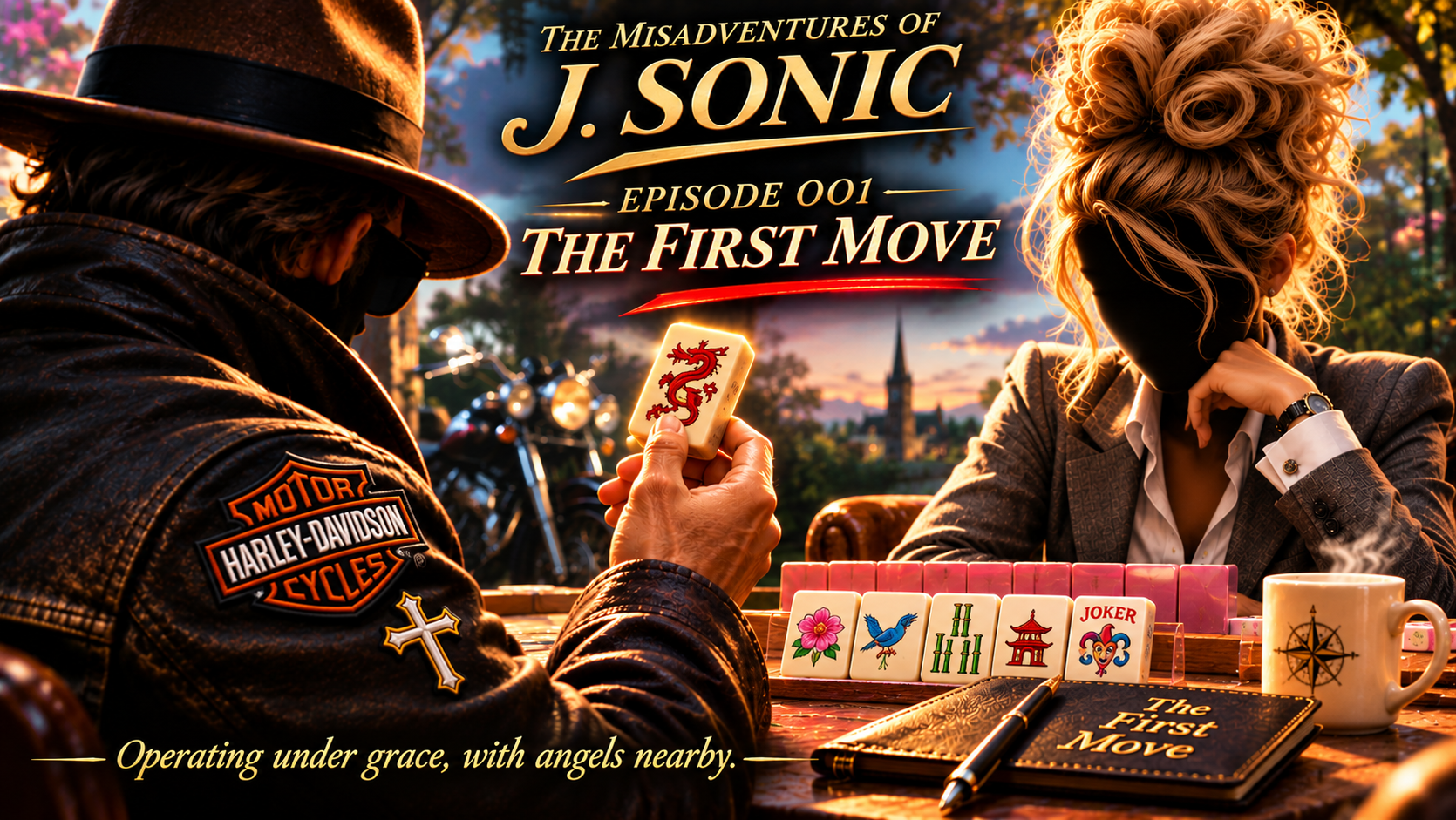
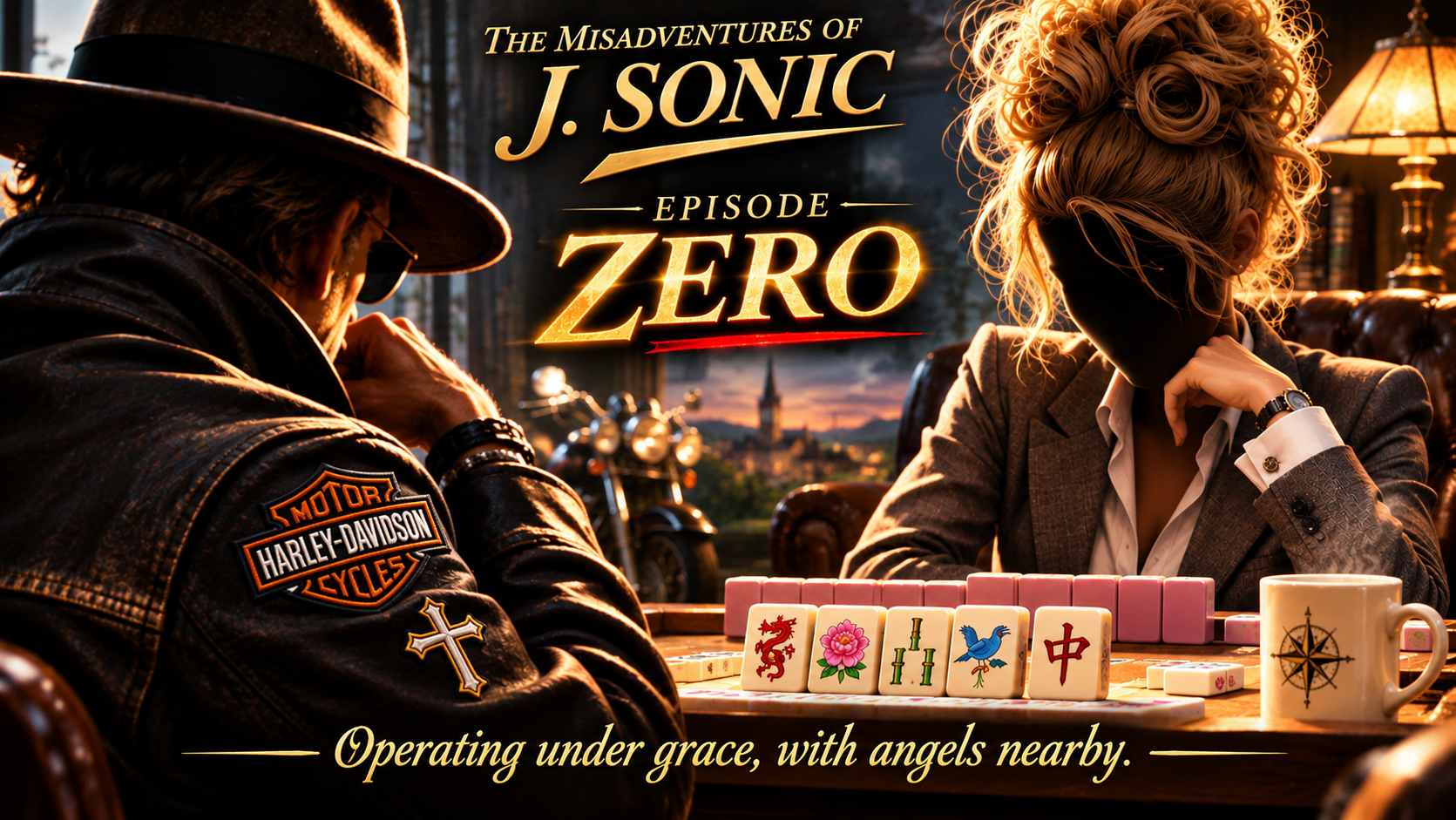
Operating under grace, with angels nearby.
There’s Nowhere to Go but Up
At precisely 6:06:06 in the morning, J. Sonic discovered that he had reached zero.
Not metaphorical zero.
Not the philosophical zero contemplated by ancient mathematicians, Eastern mystics, and people who had accidentally deleted their retirement accounts.
Actual zero.
His checking account had gone beyond zero, which struck him as mathematically offensive.
His romantic prospects were approaching zero.
His credibility with the respectable citizens of the Tiny Kingdom had been hovering around zero for years.
And the number of people who believed he was an international secret agent remained stubbornly fixed at zero.
This last statistic was particularly irritating.
After all, what kind of secret agent would he be if everyone knew?
He considered this an excellent argument.
Unfortunately, he was the only person who did.
His watch beeped.
6:06:07.
“Damn,” he whispered.
He’d missed the moment.
Again.
The Man, the Myth, the Minor Administrative Problem
J. Sonic was not his real name.
Or perhaps it was.
That was classified.
He was a man of a certain age, which is what polite society calls a man who has reached the point where his knees predict thunderstorms more accurately than the Weather Channel.
He had studied secret societies for thirty-three years.
Thirty-three.
The age of Christ at the Crucifixion, according to tradition.
The number of degrees in the Scottish Rite.
The number of vertebrae commonly counted in the human spine.
Coincidence?
Probably.
But J. Sonic wasn’t prepared to rule anything out.
His investigations had led him through Freemasonry, sacred geometry, ancient philosophy, modern politics, conspiracy theories, biblical prophecy, and a particularly disturbing rabbit hole involving the price of breakfast cereal.
He knew things.
Or at least he knew things about things.
Whether those things were true was occasionally a matter of spirited debate.
His friends called him brilliant.
His enemies called him delusional.
His bank called him overdrawn.
Of the three, the bank had the strongest documentation.
The Amateur Magister Ludi
J. Sonic had recently acquired another distinction.
He was an amateur Magister Ludi.
Master of the Game.
The title came from Hermann Hesse’s The Glass Bead Game, a novel about intellectual mastery, spiritual discipline, and the mysterious synthesis of human knowledge.
J. Sonic had found the concept irresistible.
Unfortunately, nobody in the Tiny Kingdom seemed interested in playing an imaginary game involving the entire history of human civilization.
They did, however, play American Mahjong.
This presented an opportunity.
Mahjong had tiles.
Mahjong had symbols.
Mahjong had dragons.
Mahjong had jokers.
And, most suspiciously, Mahjong had women who knew exactly what they were doing.
J. Sonic knew immediately that he had discovered something important.
He purchased a beginner’s guide, studied the rules, and declared himself an amateur master.
Not a professional master.
That would have been arrogant.
An amateur master.
He felt the distinction demonstrated remarkable humility.
His first instructor, a seventy-eight-year-old woman named Miss Birdie, disagreed.
“You can’t be a master if you don’t know how to play,” she informed him.
“That’s precisely why I’m an amateur.”
“You’re an amateur idiot.”
“That,” J. Sonic replied, “is also under consideration.”
Miss Birdie regarded him over her reading glasses.
“Pick a tile.”
He selected a dragon.
“Why that one?”
“Symbolism.”
“Wrong.”
She took the tile.
He lost the hand.
Then the next.
And the next.
By lunchtime, J. Sonic had lost eleven consecutive games to four women who appeared to be discussing grandchildren, casserole recipes, and the complete destruction of his self-esteem simultaneously.
He had never encountered such a disciplined intelligence operation.
Not even in Washington.
Especially not in Washington.
The Tiny Kingdom
The Tiny Kingdom was a beautiful place.
Its lawns were immaculate.
Its hedges were obedient.
Its citizens drove expensive automobiles at precisely the speed required to demonstrate that they were in no particular hurry.
Everyone knew everyone.
Everyone loved everyone.
And everyone knew things about everyone that everyone pretended not to know.
It was a community built on tradition, courtesy, and the ancient Southern conviction that anything unpleasant could be resolved with a committee.
J. Sonic had been the subject of several committees.
He considered this evidence of his importance.
The committees considered it evidence of their patience.
Somewhere near the center of the Tiny Kingdom stood an institution so respected, so established, and so magnificently self-assured that its leader was known simply as the Grand Custodian.
Nobody knew who had bestowed the title.
Nobody dared ask.
The Grand Custodian was a distinguished gentleman who believed in order, harmony, propriety, and making certain everyone remained exactly where they belonged.
He had always been cordial to J. Sonic.
Almost paternal.
Which was precisely what made him suspicious.
A villain who twirled his mustache was easy to identify.
A villain who offered to pay for lunch?
That required investigation.
Of course, the Grand Custodian might not have been a villain at all.
J. Sonic had been wrong before.
There was an entire filing cabinet devoted to the subject.
The Outlaw Council
Fortunately, J. Sonic was not alone.
He had the Outlaw Council.
An informal brotherhood of musicians, philosophers, renegades, recovering know-it-alls, and men who had discovered that conventional wisdom was frequently neither.
They had no constitution.
No membership dues.
No official headquarters.
And absolutely no agreement about who was in charge.
J. Sonic considered himself first among equals.
The others considered him first among people who needed supervision.
Their meetings occurred wherever coffee was available and nobody had yet asked them to leave.
The Council’s mission was simple:
Help one another survive.
Preferably with dignity.
But dignity was negotiable.
On the morning J. Sonic reached zero, he sent the Council an urgent message.
OPERATION ZERO HAS COMMENCED.
One member responded immediately.
“Do you need a ride?”
Another asked, “Have you eaten?”
A third wrote, “Please tell me you haven’t started another revolution.”
J. Sonic stared at the messages.
Thirty-three years of investigating secret networks, and here was the most powerful one he had ever discovered.
Three men willing to bring him breakfast.
He found this deeply moving.
He also wondered whether breakfast could be classified as an operational expense.
The Woman Who Changed the Equation
There was, however, one complication more dangerous than financial ruin, Mahjong, or the Grand Custodian.
A.L.
The Grand Custodian’s daughter.
Beautiful.
Intelligent.
Independent.
And possessed of the devastating ability to see through J. Sonic’s nonsense without losing affection for the man producing it.
She had once asked him a question that had nearly ended his entire philosophical career.
“Would you rather be right or happy?”
He had considered the matter.
“How long do I have to answer?”
“You’re proving my point.”
“That’s not a fair question.”
“It’s a very simple question.”
“Simple questions are frequently traps.”
She smiled.
He was finished.
J. Sonic could withstand ridicule, bankruptcy, institutional disapproval, and eleven consecutive Mahjong defeats.
But one smile from A.L. could bring his entire intelligence apparatus to its knees.
He had spent thirty-three years searching for hidden truth.
Now he was beginning to suspect that the truth might be standing directly in front of him, wondering whether he had remembered to eat lunch.
This was deeply inconvenient.
Zero Is a Very Interesting Number
That afternoon, J. Sonic returned to his desk.
On it sat a watch, a Bible, a Mahjong tile, three unpaid bills, and a notebook labeled:
TOP SECRET — DO NOT READ
Underneath, in smaller handwriting:
Especially if you are the Grand Custodian.
He opened the notebook.
At the top of a fresh page, he wrote:
ZERO.
He studied the symbol.
A circle.
No beginning.
No end.
Nothing.
Everything.
The mathematical foundation of possibility.
He smiled.
“Of course.”
Then he paused.
He had been doing this for thirty-three years.
Every coincidence was a message.
Every number was a clue.
Every setback was evidence of a larger design.
Perhaps there was a conspiracy.
Perhaps there wasn’t.
Perhaps the universe was communicating with him.
Or perhaps he simply needed to stop interpreting the expiration date on a carton of milk as a warning from the Knights Templar.
He considered the possibilities.
The milk theory remained open.
But something was changing.
For the first time in a long time, J. Sonic wondered whether understanding everything was actually necessary.
Perhaps he didn’t have to solve the Tiny Kingdom.
Perhaps he didn’t have to defeat the Grand Custodian.
Perhaps he didn’t have to become a master of the Glass Bead Game, American Mahjong, or anything else.
Perhaps he merely had to learn how to play.
And how to lose.
And how to love.
He looked at the little dragon tile on his desk.
Miss Birdie had slipped it into his pocket after the final game.
“For practice,” she’d said.
He turned it over.
There was nothing written on the back.
Naturally, he found this suspicious.
The First Move
His phone buzzed.
A message from A.L.
“How was Mahjong?”
He considered lying.
Then he remembered he was trying something new.
The truth.
“I was defeated by four grandmothers.”
“How badly?”
“Historically.”
“Did you learn anything?”
He stared at the screen.
He thought about the dragons, the jokers, the women laughing around the table.
He thought about his friends offering breakfast.
He thought about the Grand Custodian, who might be an enemy, a friend, or simply another man trying to make sense of a world he couldn’t control.
He thought about zero.
Finally, he typed:
“Yes. I learned that being a master isn’t the same as being good at something.”
Three dots appeared.
Then her reply.
“That’s a start.”
He smiled.
A start.
At zero.
Of course.
He checked his watch.
6:06:06.
Impossible.
It was afternoon.
He looked again.
The watch had stopped.
For one terrible moment, J. Sonic wondered whether this was a sign.
Then he remembered that the battery had been dying for weeks.
He laughed.
A real laugh.
The kind that comes from discovering the universe may not revolve around you after all.
He placed the watch on the desk.
Outside, the sun was beginning its descent over the Tiny Kingdom.
Somewhere, the Grand Custodian was making plans.
Somewhere, the Outlaw Council was arguing over where to eat.
Somewhere, four elderly women were preparing to annihilate another unsuspecting Mahjong player.
And somewhere in the great, mysterious machinery of creation, a man who had lost nearly everything was about to discover what mattered.
J. Sonic picked up his notebook.
Under ZERO, he wrote one final sentence:
THERE’S NOWHERE TO GO BUT UP.
Then, after careful consideration, he added:
Unless the bank charges another overdraft fee.
To Be Continued…
Next: Episode 001 — The First Move
“This is the day which the LORD hath made; we will rejoice and be glad in it.” — Psalm 118:24 (KJV)
The Misadventures of J. Sonic
© 2026 James Walton Carns Jr. All rights reserved.