Opinion: I Had to Cross a Border to Get Into My Own Facebook Account
By JC | WeRockTV
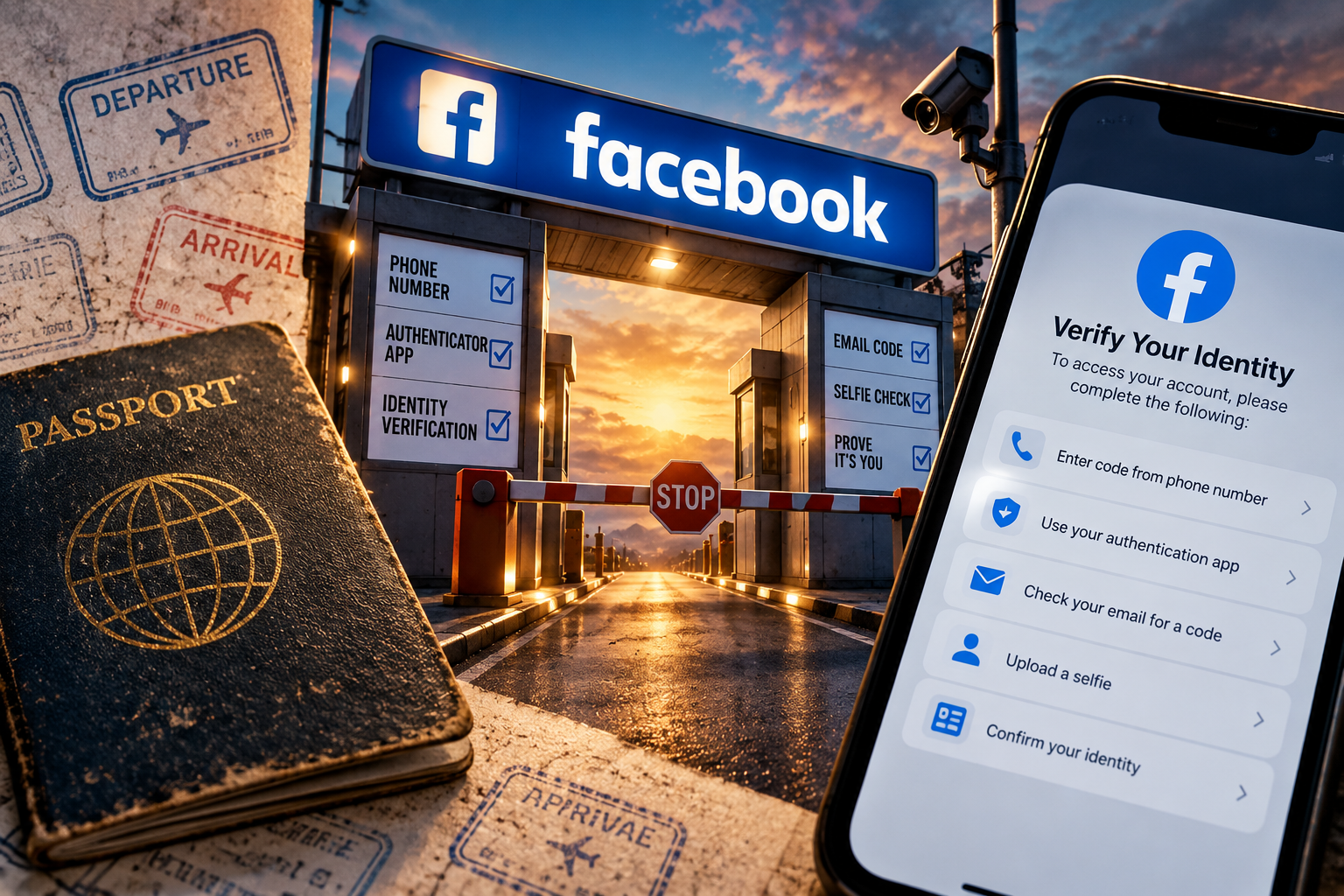
This week, I had to cross an international border just to get back into my own Facebook account.
Not literally, but close enough that I checked my pockets for a boarding pass.
It started the way most modern disasters do: with something small. I lost my old phone number.
People lose phone numbers every day. Nobody calls the National Guard. But to Facebook, losing your phone number is apparently the digital equivalent of showing up at your own front door wearing a ski mask, carrying a crowbar, and insisting you live there.
So I did what any reasonable man would do. I asked Facebook to email me a verification code.
Facebook promised it would.
Facebook lied.
I checked my inbox. I checked my spam folder. I checked every folder known to modern civilization. Nothing.
That code is still out there somewhere, wandering the internet like a lost puppy, looking for a home that no longer exists.
Next, Facebook demanded my authentication app.
I don’t have an authentication app. I barely have a calendar app.
I tapped “Try another way.”
Facebook offered me the authentication app.
I tapped “Try another way” again.
Facebook offered me the authentication app again, apparently convinced that repetition would somehow produce one.
After about the fifteenth attempt, I began to suspect that “Try another way” was not a button. It was a psychological experiment.
Somehow, I eventually landed in an old Facebook account I had created fifteen years ago and forgotten about. A digital ghost from another lifetime.
I didn’t want that account.
That account, however, seemed delighted to have me.
Finally, after what felt like an entire season of my life, Facebook offered me the ultimate identity test.
Scan your passport.
Not simply a photograph of my passport. Facebook wanted me to scan the actual electronic chip embedded inside it.
I didn’t even know my passport had a chip. I thought the only chips in my house were in the pantry.
So there I sat, phone case removed, passport open, sliding my phone across the pages like a man searching for buried treasure with a metal detector.
The screen said move slowly.
I moved slowly.
The screen said hold still.
I held still.
I prayed. I negotiated. I may have used a few words my mama would not have approved of.
I half expected a customs officer to climb out of my phone and ask whether I had anything to declare.
I did.
Frustration, mostly.
And fifteen years of memories.
Then, suddenly, sweet glory:
“Chip read successfully.”
Hallelujah.
I had crossed the border.
I was back in Facebook.
No visa required.
And that’s where the funny part ends and the important part begins.
Fifteen Years in the Rearview Mirror
Once I got back inside, I started scrolling.
Fifteen years of photographs, music, prayers, birthdays, friendships, family memories, and, if I’m being honest, more political arguments than any grown man ought to admit.
Some of those memories made me smile.
Some made me laugh.
Some broke my heart.
And some made me wonder what on earth we were all thinking.
I saw comment threads that went on for days. Friends who became strangers. Family members who once exchanged recipes exchanging insults instead.
And I saw myself.
I wasn’t always particularly proud of the man staring back at me from those old conversations.
Somewhere along the way, we turned something that was supposed to connect us into something that divided us.
Facebook became a battlefield.
Cousins stopped speaking at Thanksgiving. Brothers and sisters drew lines in the sand over politicians who will never know their names, visit their homes, or sit beside them in a hospital waiting room.
We gave strangers on television the power to divide people who once passed the mashed potatoes to each other with a smile.
Think about that.
We allowed people who don’t know us to come between people who love us.
And for what?
To win an argument?
To prove somebody wrong?
To collect a few thumbs-up from people who already agree with us?
What a terrible bargain.
The Things We Have in Common
Here’s something I’ve come to believe.
Most of us want remarkably similar things.
We want our children and grandchildren to grow up safe, healthy, and free.
We want honest work, decent neighbors, strong communities, and a country worth loving.
We want our families to flourish.
We want to be treated fairly.
We want our lives to mean something.
And when the day is done, most of us would rather sit on a porch with somebody we love than spend another evening arguing with somebody we don’t know.
We disagree about how to accomplish those things.
Sometimes profoundly.
But disagreement doesn’t have to become hatred.
Disagreement is not the enemy. Contempt is.
The moment we stop seeing another human being and start seeing only a Republican, a Democrat, a conservative, a liberal, or some other convenient label, we’ve already surrendered something precious.
Our humanity.
And no election can give that back to us.
The Politics of Reconciliation
Reconciliation is not surrender.
It doesn’t mean abandoning your convictions, ignoring injustice, or pretending that serious differences don’t exist.
It doesn’t mean accepting mistreatment or abandoning healthy boundaries.
It means recognizing that another person’s humanity is not conditional upon their agreement with you.
It means choosing conversation over condemnation.
Curiosity over certainty.
Humility over humiliation.
And sometimes it means saying three of the hardest words in the English language:
“I was wrong.”
Or four words that can be even harder:
“Will you forgive me?”
Families need that.
Marriages need that.
Friendships need that.
Churches need that.
And Lord knows America needs that.
We’ve become so accustomed to fighting that sometimes we forget what peace even looks like.
But peace isn’t the absence of disagreement.
Peace is learning how to disagree without destroying one another.
The Answer Was Never in Washington
Here’s where my faith comes into the picture.
I’ve spent plenty of years following politics, arguing about politics, and believing that the next election might finally straighten everything out.
But politicians come and go.
Parties rise and fall.
Campaign slogans change.
The outrage machine simply finds another reason to keep running.
Meanwhile, the words of Jesus remain.
“Jesus Christ is the same yesterday, and today, and forever.” — Hebrews 13:8
Jesus didn’t assemble a group of disciples who agreed about everything.
He brought together fishermen, a tax collector, a zealot, and ordinary people from very different walks of life.
Imagine the political conversations around that dinner table.
Matthew had collected taxes for Rome. Simon was called the Zealot.
Those two probably wouldn’t have agreed on much.
Yet Jesus called them both.
He didn’t tell them to form competing political action committees.
He called them to follow Him.
To love one another.
To forgive.
To serve.
To become something greater than the divisions of their day.
And He gave them a standard by which the world would recognize His followers:
“By this shall all men know that ye are my disciples, if ye have love one to another.” — John 13:35
Not by our political affiliations.
Not by our clever arguments.
Not by how many people we can embarrass on social media.
By our love.
That’s a much higher standard.
And a much harder one.
A Different Kind of Facebook
So here’s my promise.
I fought my way back into this account armed with a passport, a prayer, and approximately three ounces of patience.
I’m not going to waste the opportunity.
I want to use this space differently.
Less fighting. More listening.
Less outrage. More understanding.
Less keeping score. More making peace.
More music.
More laughter.
More prayers.
More good news.
More grace.
And more room at the table for people who see the world differently than I do.
If I’ve hurt you with something I’ve posted over the years, I’m sorry.
If we’ve drifted apart over politics, I hope we can find our way back toward friendship.
If we disagree, that’s okay. We can still care about one another.
We can still share a meal.
We can still laugh at the same joke.
We can still pray for each other.
And perhaps, if we’re willing, we can discover that the things connecting us were always more important than the things dividing us.
I’m not suggesting that every broken relationship can be repaired overnight. Some wounds run deep. Some require time, accountability, forgiveness, and boundaries.
But reconciliation has to begin somewhere.
Maybe it begins with a phone call.
Maybe a cup of coffee.
Maybe a simple message that says, “I’ve been thinking about you.”
Maybe it begins with deciding that we don’t need to win every argument.
Maybe it begins with remembering that the person on the other side of the screen is somebody’s son, daughter, mother, father, brother, or sister.
Somebody Jesus loves.
And maybe that’s enough to begin again.
After all, if I can cross an international border to recover a Facebook account, surely we can cross a few political boundaries to recover a friendship.
The world doesn’t need another argument. It needs another act of love.
And one final thing.
After everything I’ve been through this week, I’ve made one more solemn promise.
I will never, ever log out of Facebook again.
Unless, of course, Jesus Himself asks me to.
And even then, I may need a verification code.
JC | WeRockTV
Good News. Good Music. Good Works.
The borders that matter most aren’t between countries. They’re between hearts. And those are the borders love was meant to cross.