The First Rebellion
The first rebellion of my life was not particularly impressive. Nobody called the police. No windows were broken. I simply decided that an instruction, however reasonable, became less attractive the moment somebody gave it to me.
This was not a philosophy. It was a reflex.
I was growing into the age when a boy discovers that adults can be wrong and promptly concludes that he must therefore be right. It is a thrilling discovery, especially before experience begins submitting its objections.
At home, there were expectations about school, church, manners, and the general appearance of being raised properly. I understood them. Most made sense. Yet I had begun to resent the assumption that understanding a rule required agreeing with it.
I wanted reasons.
Sometimes I received them. Sometimes I received the ancient parental answer that had survived civilizations, wars, and countless kitchen tables: because I said so.
I found this unsatisfactory.
Music offered an alternative government. A drummer could establish the tempo, but everyone still had a voice. A guitarist could wander away from the melody and return with something beautiful. Even silence had a purpose. I was beginning to think freedom might work like that.
Naturally, I overlooked the hours of practice required to make a band sound free.
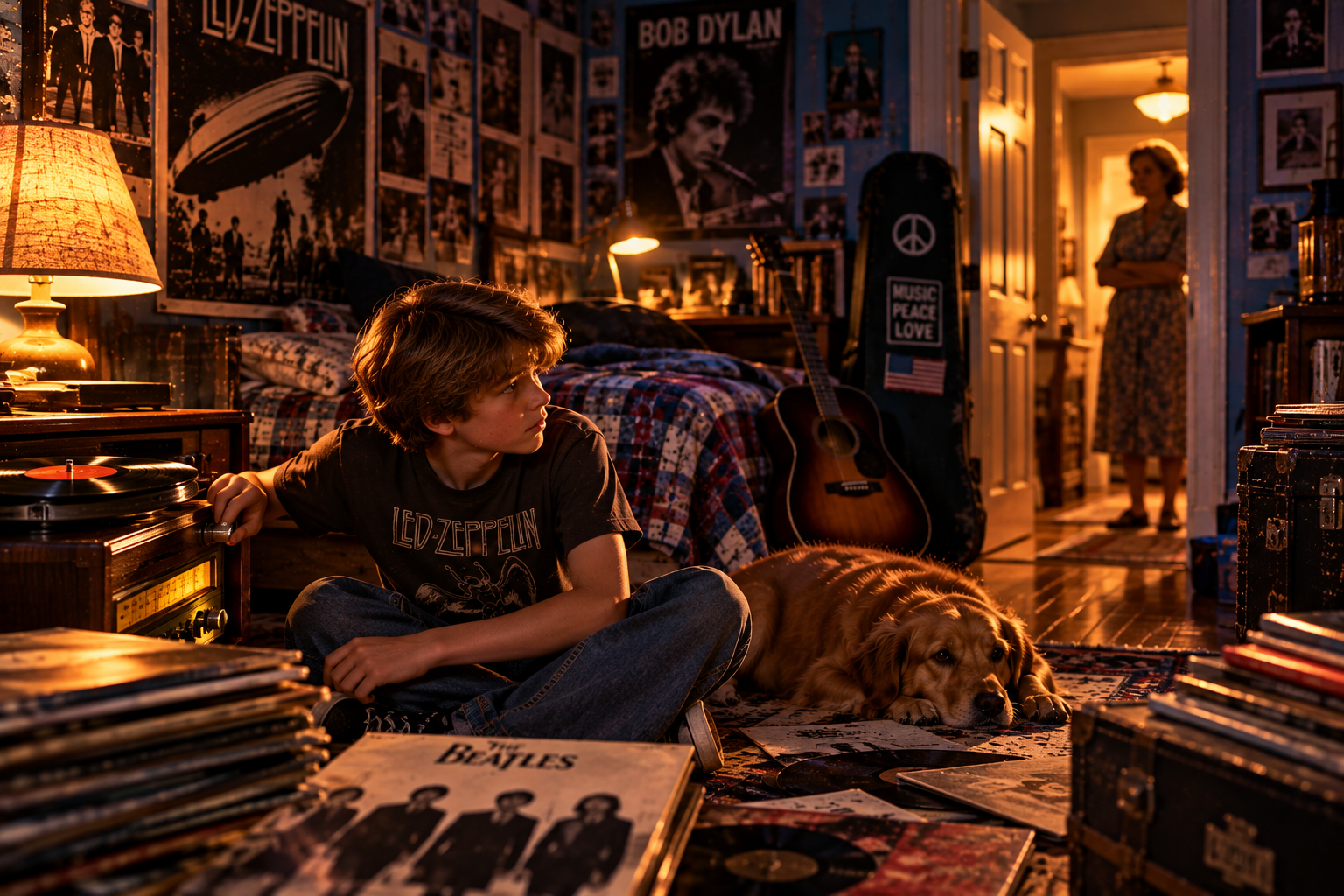
One evening, in a scene I can reconstruct more clearly in feeling than in fact, I sat with a record playing louder than anyone else wanted. A voice called from another room. Turn it down. I lowered the volume just enough to claim compliance and not enough to demonstrate goodwill.
The voice returned.
This time I turned the knob until the music disappeared.
The sudden quiet felt like defeat.
I remember the heat of embarrassment more than the words exchanged. I had wanted to be treated like someone capable of making decisions. Instead, I had made a small decision badly and insisted it was a matter of principle.
The irony would have escaped me then.
Later, I sat alone and listened to the faint sounds of the house. Footsteps. Water running. A chair moving across the floor. I could have walked into the kitchen and apologized. Nothing terrible had happened. The distance between us was perhaps twenty feet.
But pride has a remarkable ability to turn a hallway into a continent.
I stayed where I was.
For years afterward, I would repeat variations of that evening. The subjects grew larger. The arguments became more complicated. I learned to speak confidently, to defend a position, to find the weakness in another person’s reasoning. I was slower to learn when a discussion had stopped being useful.
There is a peculiar loneliness in winning an argument nobody wanted to have.
I don’t mean that obedience is always wisdom. Some rules deserve examination. Some authorities make mistakes. A person who never asks questions may live peacefully, but peace purchased with silence can become another kind of prison.
Still, not every instruction is oppression. Sometimes somebody asks you to lower the music because they are tired.
It took me an astonishing amount of time to appreciate that possibility.
The Bible tells of a son who demanded his inheritance and went away. I was fascinated by his departure, less interested in the hunger that followed. I liked the part where he chose his own road. I did not yet understand the courage required to turn around.
That would come later.
For now, the rebellion ended without ceremony. Morning arrived. Breakfast appeared. Ordinary life resumed, as it usually does after a household disagreement. Nobody declared victory. Nobody issued a formal pardon.
I had learned almost nothing, which did not prevent me from feeling older.
But a small question remained. What if freedom meant more than refusing to be told what to do? What if it meant choosing the right thing when nobody could make you?
I could not answer it yet.
I put the record back in its sleeve and carried it to the shelf.
Then, for once, I left the volume alone.