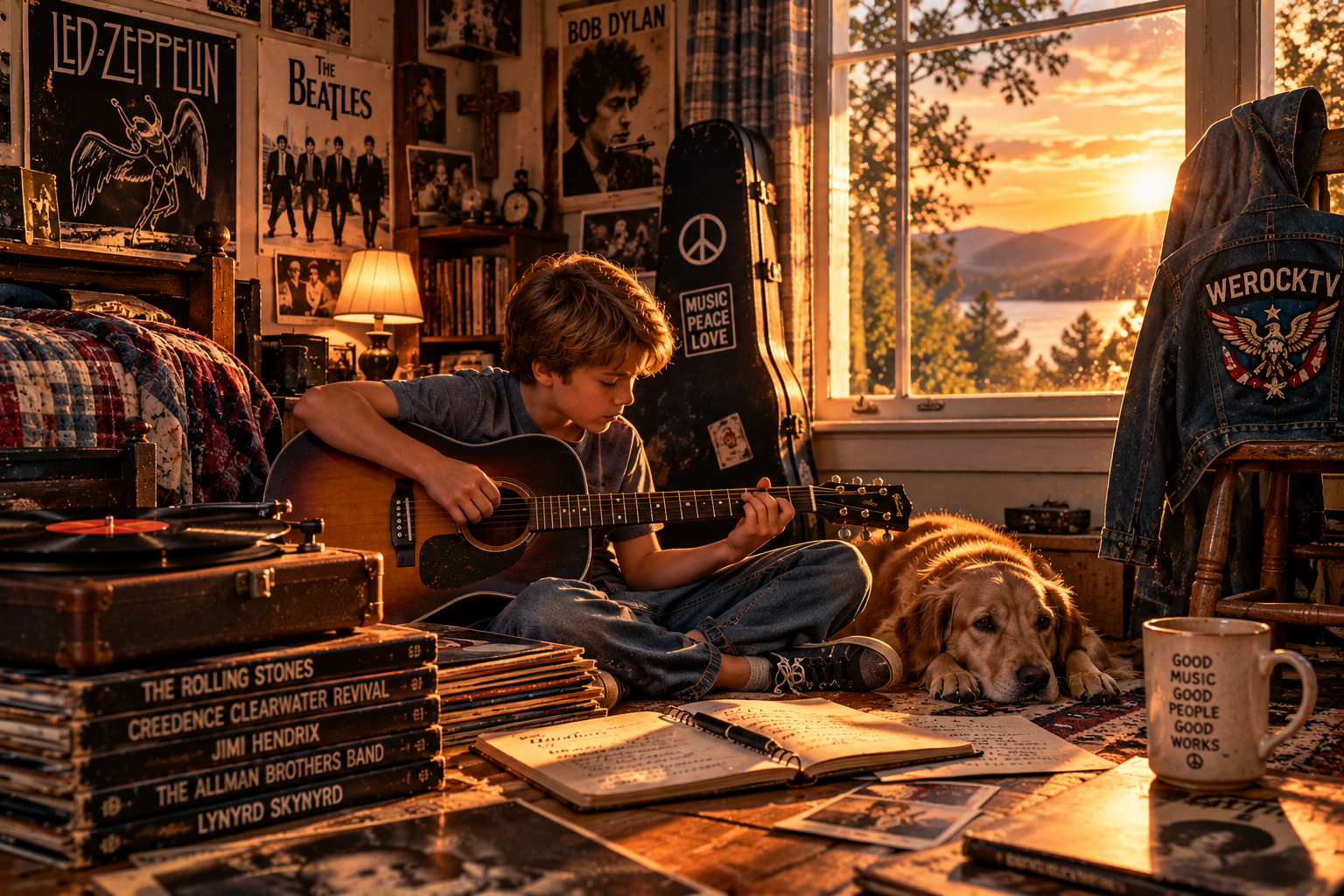
The Music Between the Notes
Some boys collected baseball cards. I collected sounds.
Not deliberately, at first. A screen door had a rhythm. Rain on a tin roof could hold a note longer than any choir member. The refrigerator clicked before it started humming, and the neighborhood dogs conducted their evening arguments in several incompatible keys.
I was beginning to suspect the world was a band that had never rehearsed.
The radio made better sense. Turn the dial and somebody, somewhere, had organized all that noise into something worth hearing. A voice came through the speaker, followed by a guitar, and suddenly an ordinary afternoon became a place I wanted to stay.
I didn’t understand the business of music. I knew nothing about contracts, record companies, or the peculiar talent required to get five musicians into one vehicle on time. I understood only that songs could change the temperature of a room without touching the thermostat.
The grownups had their music. Church had its hymns, the kitchen had its radio, and passing cars carried pieces of other people’s lives through open windows. I liked the hymns, especially when the congregation stopped sounding like individuals and became one enormous, imperfect voice. But rock and roll contained a different invitation. It suggested there might be something beyond the familiar streets, and that perhaps I could find it by listening closely enough.
I started noticing guitars everywhere. Their shapes seemed improbable: wood and wire arranged to make a human heart answer back. Some were polished and expensive. Others looked as though they had survived a house fire and were considering another. I wanted to touch every one.
Wanting, however, is not playing.
Playing requires the humiliating discovery that your fingers have opinions of their own. A chord looks simple until you try to hold it. One string buzzes, another refuses to ring, and your hand begins to resemble a small animal caught in a trap.
I loved it anyway.
There was honesty in the difficulty. A guitar did not care about your family name or whether the neighbors thought you promising. It answered what you actually did. Press the string badly and the note suffered. Try again, adjust your hand, listen carefully, and something improved.
I wish every relationship had offered such immediate feedback.
At home, expectations sometimes arrived before explanations. At school, success came with grades and rules. Music gave me a different measurement: could I hear yesterday’s mistake and make today’s attempt a little better?
That question followed me long after childhood.
I learned, too, that a song could carry sorrow without collapsing beneath it. Some voices sounded joyful until you listened to the words. Others sang about heartbreak with such energy that people danced. The contradiction fascinated me. Human beings could feel two things at once, and music didn’t demand that they choose.
Neither did the Bible, though I hadn’t realized it yet. The psalms were full of praise and complaint, gratitude and bewilderment. David could sing about green pastures and then ask why God seemed so far away. Perhaps faith was not the absence of difficult questions. Perhaps it was the courage to keep singing them.
I wouldn’t have put it that way as a boy. I probably would have asked somebody to turn up the radio.
Still, an idea was taking shape. I wanted to make something that reached another person without requiring me to stand in front of him and explain myself. A song might travel farther than an argument. It might even arrive where an apology couldn’t.
Years later, I would discover how badly I needed both.
But that afternoon belonged to possibility. The sun moved across the floor. Somewhere a record ended, leaving a faint hiss before the needle lifted. I sat listening to the silence it left behind, already waiting for the next song.
I had no audience, no band, no destination. Just two ears, an imagination, and a growing suspicion that my life would somehow be measured in music.
For once, I was right.