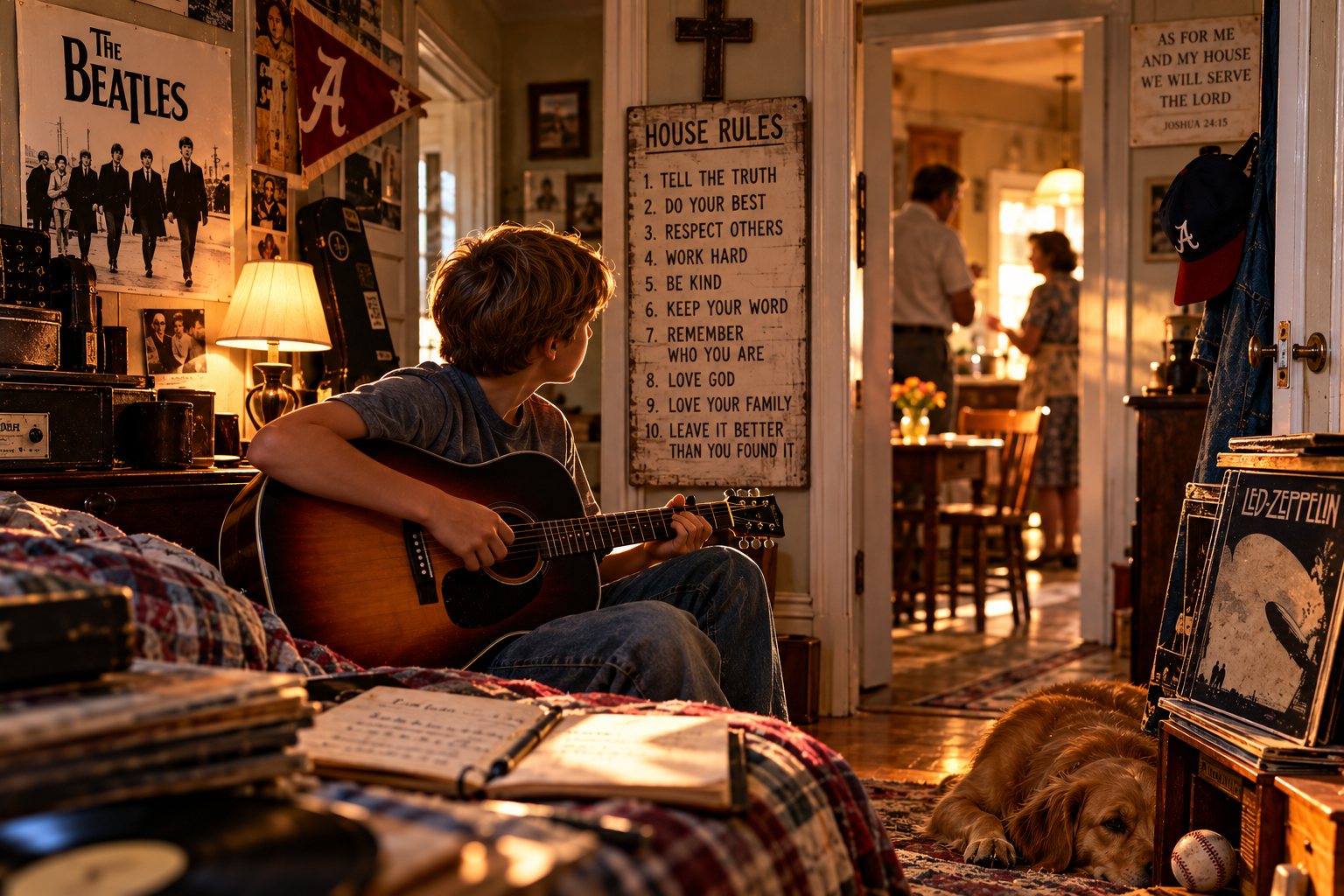
The House Rules
Every family has rules. Some are written down, usually on the refrigerator, where they compete with grocery lists and invitations to events nobody wants to attend. Others live in the walls. You learn them by watching faces change when certain subjects enter a room.
In our house, respect was important. So was hard work, a firm handshake, and remembering that whatever you did outside would eventually find its way home. Alabama was a place where news traveled faster than the people involved, particularly when the news was embarrassing.
I learned early that a name could open doors. I also learned that it could make the doorway feel narrow.
My father belonged to the world of decisions. He had places to be, people to meet, matters requiring answers. I admired that certainty. When he spoke, he often sounded as though the question had already been settled. I wanted to sound like that someday, although I had not yet settled anything more consequential than which record to play.
My mother had a different authority. She could detect trouble in the silence before anyone confessed to causing it. She understood that a boy might say he was fine while carrying an entire thunderstorm behind his eyes. I did not always appreciate her questions. I appreciated them later.
At church, authority wore its Sunday clothes. Men prayed aloud. Women sang with conviction. Children sat still, or attempted an imitation convincing enough to escape notice. I listened to sermons about obedience, forgiveness, and the prodigal son. The prodigal interested me. He got to leave, make terrible decisions, and still find somebody waiting on the porch.
I wondered what happened to the son who stayed.
It was not rebellion, exactly. I loved my family. I wanted their approval, perhaps too much. But somewhere inside me was a small insistence that a person ought to discover his own reasons for believing things. Repeating the correct answer never felt quite the same as understanding it.
That habit made me inconvenient.
At school, teachers asked questions with answers printed in the back of their books. I preferred questions that refused to stay put. Why did people say one thing and do another? Why did a song make grown men cry? Why could two people remember the same afternoon so differently?
Nobody had assigned those questions for homework.
Music gave me a place to put them. I could listen to a guitar line and hear someone pushing against a boundary without breaking anything. A song could be disciplined and unruly at once. It obeyed the beat while refusing to march.
I liked that contradiction. I recognized myself in it.
Looking back, I see how easily a boy can confuse independence with opposition. If somebody told me to turn left, right suddenly acquired a philosophical appeal. I was not always defending a principle. Sometimes I was defending the pleasure of choosing.
There is a difference, and it took me years to learn it.
I also see that the adults were human beings carrying histories I knew almost nothing about. Their rules had origins. Some came from love. Some came from fear. Some were inherited without inspection, like furniture nobody remembered buying.
I would inherit a few myself.
The trouble with growing up is that you eventually become responsible for deciding which lessons deserve to survive. You cannot blame the house forever. At some point, you are the one holding the hammer, choosing what to repair and what to tear down.
Years later, I would discover that the hardest rule was spoken: do not disappoint the people who love you. It sounds noble until you realize disappointment is unavoidable. You can spend a lifetime performing for an audience that never agreed on the script, then wonder why the applause feels.
That afternoon, though, I was only a boy, listening to music behind a closed door, certain the world outside was waiting for me.
I did not yet know how much of that house I would carry with me.