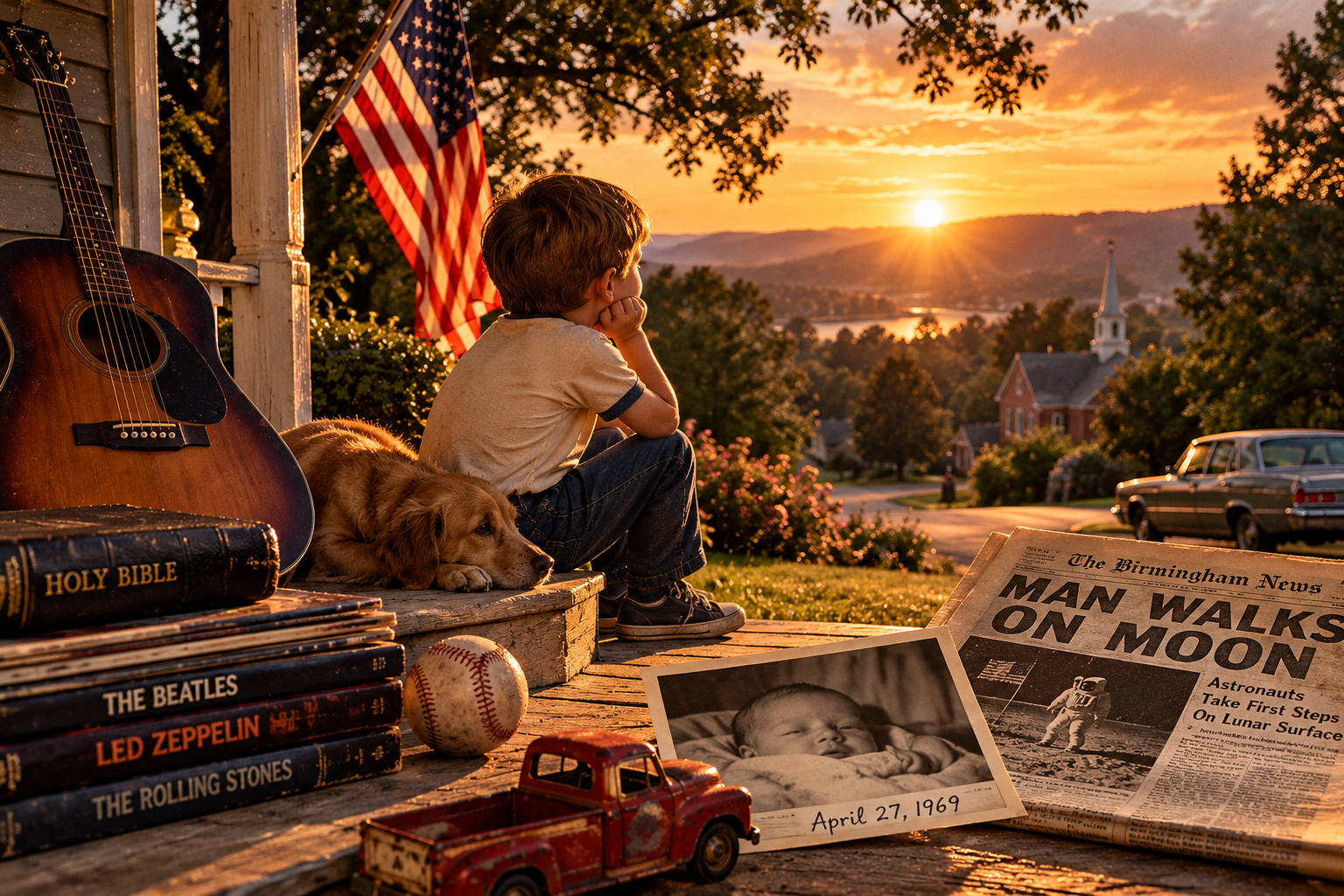
The Day the Story Began
I was born on April 27, 1969, which means I arrived just in time to miss the moon landing and spend the rest of my childhood hearing about it. The world was looking up. I was mostly concerned with being fed.
Nobody asked whether I wanted to be born into this family, in this particular corner of Alabama. That’s how beginnings work. Somebody else chooses the setting, hands you a name, and leaves you to discover what the name will cost.
I grew up surrounded by people who believed in work, reputation, and the importance of appearing to know where you were going. There was affection in our house, though affection could sometimes arrive dressed as advice. Adults had opinions about nearly everything. Children were expected to develop good manners before developing counterarguments.
I developed both, eventually, though not in the recommended order.
My earliest memories don’t arrange themselves neatly. They come as sounds and flashes: a screen door closing, a voice calling from another room, the particular silence that followed a question nobody wanted to answer. Memory is less like a photograph album than a radio searching for a station. Sometimes the music comes through clearly. Sometimes all you get is static.
What I remember most is wanting to belong. I wanted the grownups to be proud of me, wanted to be good at something, wanted to understand why certain words could fill a room with warmth while others emptied it. I had no language for those mysteries. I only knew they were there.
Church offered a language, or at least the beginning of one. I learned that God could see everything, which struck me as both comforting and inconvenient. The stories were enormous: seas opening, shepherd boys facing giants, a carpenter’s son forgiving people who had done terrible things. I wondered what forgiveness looked like on an ordinary Tuesday, when nobody was parting a sea and the kitchen still needed cleaning.
Music made a different kind of promise. A song could say what people couldn’t. It could make a lonely person feel accompanied without asking him to explain why he was lonely. Before I knew chords or stages or amplifiers, I understood that much. A melody could walk into a room and change the weather.
I would spend years chasing that feeling.
Of course, childhood wasn’t one continuous revelation. There were scraped knees, school mornings, ordinary embarrassments, and the small indignities of being told to put on a jacket when I wasn’t cold. I made mistakes long before anyone thought to call them character flaws. Most children do. The trouble comes when adults forget they once did too.
Looking backward, I’m tempted to draw straight lines from that boy to the man holding a box marked KEEP. It would make the story easier. A childhood incident could explain every later decision; one sermon could predict every future doubt. But lives don’t unfold like that. We change direction. We contradict ourselves. We surprise the people who think they know us, especially ourselves.
Still, something of that boy survived. He wanted to make people laugh, but more than that, he wanted them to listen. He wanted love without having to earn it every morning. He wanted the world to make sense, and when it didn’t, he looked for a song.
I don’t know whether the adults around me could have guessed what lay ahead. Neither could I. That’s a mercy given to children: they get to wake up without carrying tomorrow’s disappointments.
I wish I could tell him to be gentler with the people who love him. But warnings travel poorly backward through time, and he would mistake my voice for an adult giving advice.
For now, let him remain a boy in Alabama, listening to the house breathe, certain that somewhere beyond its walls there is a larger world. He hasn’t learned to play the guitar. He hasn’t broken anyone’s heart, including his own. He has time.
And somewhere, waiting patiently, is the first note.