
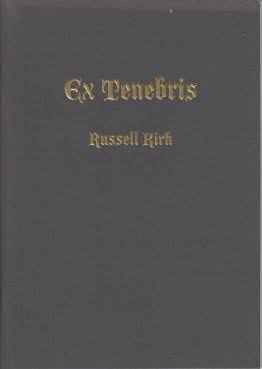
Russell Kirk’s short story “Ex Tenebris” (Latin for “out of darkness”), first published in 1957, is a chilling ghostly tale set in the decaying English village of Low Wentford. The narrative centers on the last remaining resident, the elderly Mrs. Oliver, who clings to her humble cottage amid a landscape ravaged by war, economic decline, and modern “progress.” Once a thriving community tied to the Ogham family estate, the area has been depopulated as farms are sold off, villagers migrate to industrial mills, and the land falls under bureaucratic control.
A government planning officer, S.G.W. Barner, embodies the cold utilitarianism of mid-20th-century central planning. Driven by an Act of Parliament and visions of efficiency, he seeks to evict Mrs. Oliver, demolish the remaining structures, and repurpose the site—perhaps as a dump for urban excavations or part of larger schemes like garden cities and state camps. This represents the erasure of traditional rural life in favor of centralized, impersonal redevelopment.
Kirk weaves in supernatural elements: a ghostly vicar or spectral presences emerge from the shadows to confront Barner’s hubris, delivering ironic enlightenment and retribution. The story serves as a cautionary fable against the dehumanizing forces of modernism, utilitarianism, and the loss of community, place, and moral rootedness.
The user’s description captures its essence well: a warning myth about the globalist-inspired future world system—centralized control, displacement, and cultural obliteration—scaled down to an intimate old English village. Kirk’s elegant, leisurely prose evokes a bygone era when words and human connections held more weight, contrasting sharply with the story’s bleak vision of mechanized, soulless “progress.”